
The 18 ChakraVerse Bible Decode · Study 01 · John 2:1–11
By Iris J Chapman
Central theme: Turning water into wine is not the moment Jesus becomes capable of sustaining Christ consciousness. It is the demonstration that the capacity has already been developed.
Introduction: What If the Miracle Was Not About the Wine?
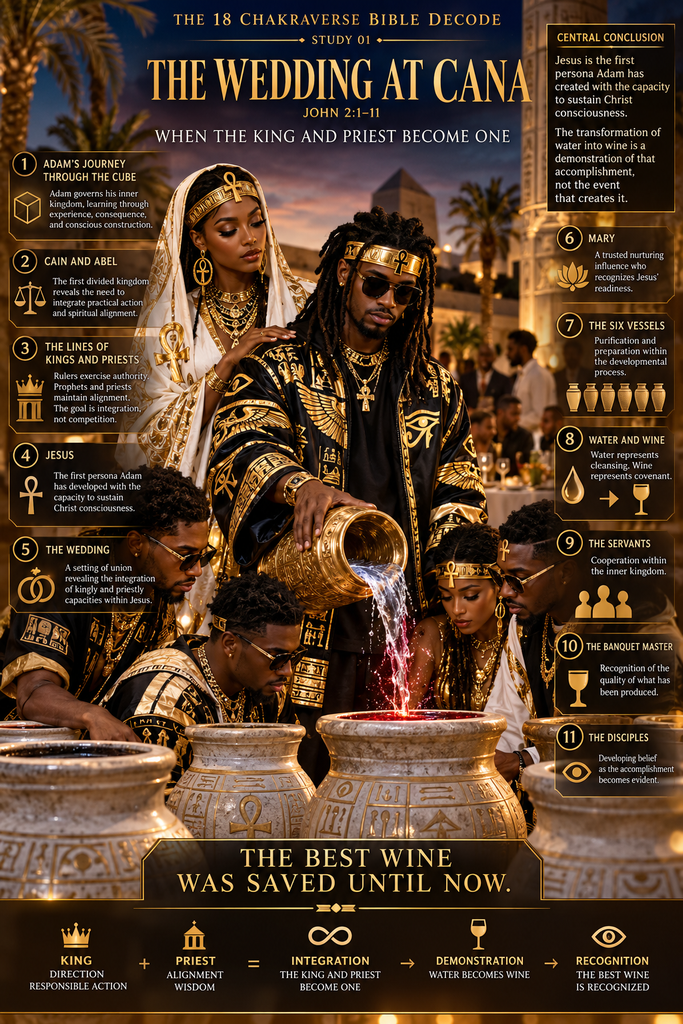
The Wedding at Cana is one of the most familiar miracles in the Bible. Jesus attends a wedding with his mother and his disciples, and partway through the celebration the wine runs out. Mary brings the problem to Jesus. He tells the servants to fill six stone vessels with water, and when the governor of the feast tastes what is drawn from them, the water has become wine.
The governor is astonished. The best wine, he says, has been kept until now.
John calls this the beginning of Jesus’ signs. Through it, Jesus “manifested forth his glory; and his disciples believed on him” (John 2:11, KJV).
Traditionally, the account is read as a display of divine power, an act of compassion, or the opening of Jesus’ public ministry. But what happens when we read it as an allegory of the developing inner kingdom? What if the central question is not how water became wine, but what Jesus had already become capable of doing?
In the 18 ChakraVerse, the Bible is read as one continuous account of Adam learning to govern his inner kingdom. Every character, circumstance, conflict, and outcome is a chance to study that development.
Cana marks a milestone in Adam’s journey. For the first time, Adam has constructed a persona capable of sustaining Christ consciousness. That persona is Jesus, and the wedding reveals something extraordinary about him:
The king and the priest have become one.
1. Adam’s Journey Through the Cube
To understand Cana, we have to begin with Adam.
In the 18 ChakraVerse, Adam represents humanity, male and female. Adam is the conscious creation entrusted with developing and governing an inner kingdom. Adam is not the Creator of the universe; that jurisdiction belongs to Source. Adam’s jurisdiction is the inner kingdom: the intentions, choices, characteristics, patterns, and personas Adam develops.
Eve represents the Spark of the Holy Spirit, the living capacity through which Adam’s intentions can take part in manifestation. Eve belongs to Source, not to Adam, and operates within the greater order the Creator established. Adam is responsible only for what he chooses to construct.
The Cube is the structured environment of Adam’s development. Within it, Adam meets circumstances, makes decisions, lives with the consequences, and learns to tell what serves the Creator’s purpose from what does not. Consequence is the teacher.
One incarnation may look nothing like another. Adam may know wealth or poverty, authority or subordination, security or instability. But the assignment never changes: Adam must learn to govern the inner kingdom.
This is why the biblical narrative is full of rulers, prophets, priests, servants, families, and nations. In this reading, they are not only accounts of outside institutions. They also reveal the challenge of governing the inner community Adam has built.
And that community does not cooperate automatically just because Adam created it. Each persona develops its own characteristics, tendencies, and patterns of action, and Adam must learn to govern them. Cana shows what becomes possible when that development reaches a new level of integration.
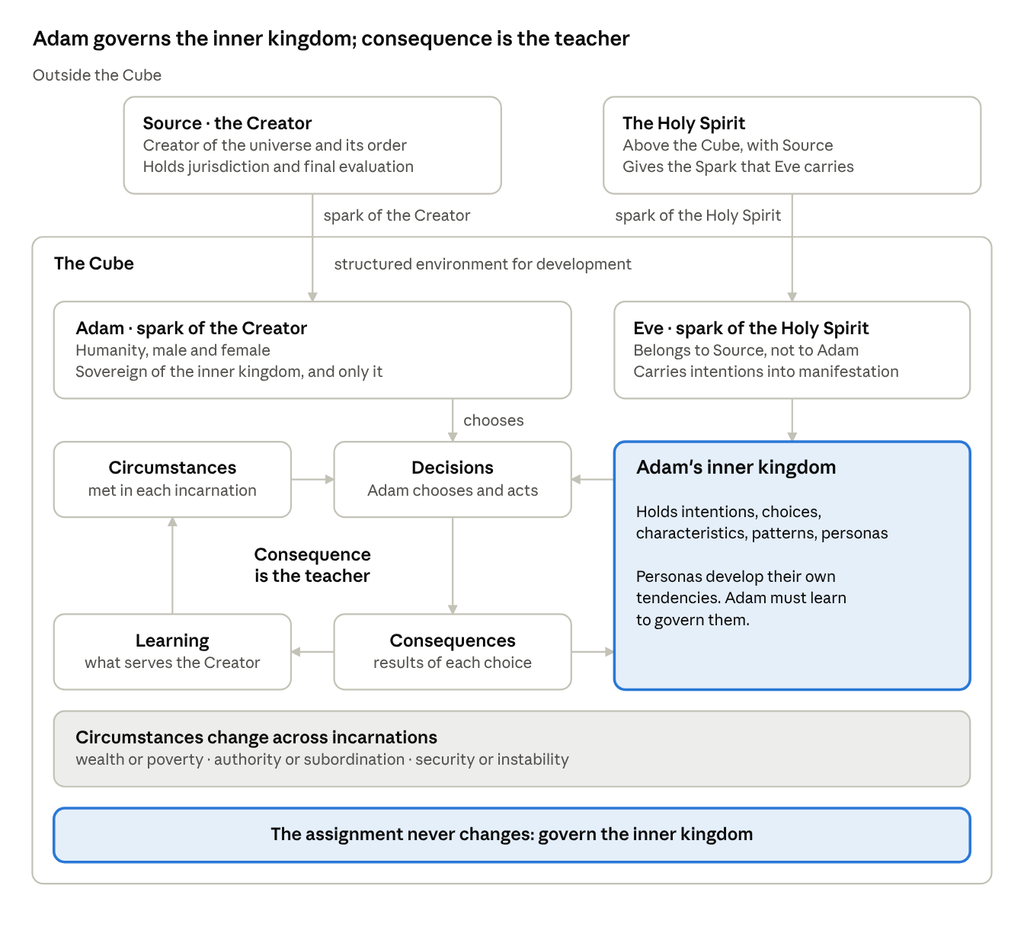
Adam’s journey through the Cube
Source and the Holy Spirit are above and outside the Cube. Inside it are Adam, a spark of the Creator, and Eve, a spark of the Holy Spirit, where circumstances, decisions, and consequences keep training the inner kingdom Adam must learn to govern.
2. Cain and Abel: The First Divided Kingdom
The struggle begins long before Cana. In Genesis 4, Adam’s development is pictured through Cain and Abel.
In the 18 ChakraVerse, Cain represents a shadow-in-service persona. He carries traits useful for a hard external world: he can protect, compete, confront, and act decisively. These capacities are not evil in themselves. Governed well, they have a legitimate function.
Abel represents an aligned persona, one whose characteristics fit more directly with the Creator’s purpose for Adam.
The trouble begins when Adam discovers that what Abel represents receives divine favor, while Cain’s offering does not. Adam faces a developmental conflict: the qualities that seem most useful for surviving the outer world are not necessarily the ones that satisfy the Creator’s evaluation.
Instead of learning to govern both, Adam lets the conflict destroy their cooperation. Cain kills Abel. Read allegorically, Adam sacrifices an aligned capacity because he has not yet learned to reconcile spiritual alignment with the practical demands of life.
But the problem cannot be solved by removing one side. Adam needs the capacity to act, and Adam needs the capacity to stay aligned.
The task is not to choose the king over the priest, or the priest over the king. The task is to develop both under proper governance.
That problem runs through the rest of the biblical narrative.
3. The Long Development of Kings and Priests
As the story unfolds, two developmental lines become clearer: one of rulers and kings, the other of prophets, priests, and messengers.
The rulers show the challenge of exercising authority. They must decide, establish order, face opposition, and govern. Yet again and again, the accounts show what happens when authority is cut off from wisdom, humility, or obedience to God.
The prophetic and priestly line shows another dimension. These personas listen, evaluate, counsel, correct, and hold up the Creator’s standards. Yet spiritual knowledge alone does not produce effective governance.
So the tension between power and alignment keeps resurfacing. Rulers resist correction. Messengers are rejected. Institutions meant to preserve alignment become corrupted.
The pattern continues because Adam is still learning: learning to govern without abandoning alignment, and to stay aligned without surrendering the responsibility to act. These accounts are evidence of training through consequence. Every success and every failure feeds the development of the inner kingdom.
The goal is not an impressive ruler who ignores the Creator. Nor is it a spiritually knowledgeable persona who cannot exercise responsible authority. The goal is integration:
- a king who can act in alignment
- a priest who can take part in governance
- a persona in whom these functions no longer compete for control
This brings us to Jesus.
4. Jesus: The Accomplishment Before the Demonstration
In the 18 ChakraVerse, Christ is not simply another name for a persona. Christ is an accomplishment: sustained alignment with the Creator’s purpose for Adam. Jesus is the first persona Adam has constructed with the capacity to sustain that state of consciousness.
The distinction is essential. Jesus does not become capable of Christ consciousness because he turns water into wine. He turns water into wine as a demonstration of a capacity already established. The wedding does not create his readiness; it reveals it.
Think of a musician. No one becomes skilled at the moment of a successful performance; the performance reveals the practice that came before. A ruler does not acquire wisdom by issuing one sound judgment; the judgment shows a capacity that already exists. In the same way, Cana is an inner accomplishment becoming visible through action.
Jesus carries the integrated capacities Adam struggled to develop through every earlier account. He can exercise authority without abandoning alignment. He can respond to a need without surrendering discernment. He can direct cooperative action without confusion over jurisdiction.
Melchizedek might seem to come first, since Genesis 14:18 presents him as both king of Salem and priest of the most high God. But Melchizedek is not a persona of Adam. He is a messenger of the Most High, sent from Source. He reveals the king-priest order to Adam; he is not Adam’s construction. That is why Scripture calls Jesus a priest “after the order of Melchizedek” (Psalm 110:4; Hebrews 7). The order comes from Source. Jesus is the first persona Adam has built who can sustain it.
The king and the priest are no longer opposing functions. They work together.
5. The Wedding: A Union Already Taking Place
A wedding is a fitting setting for this revelation. Marriage symbolizes union: two distinct participants entering a covenant in which cooperation is central. Cana is a wedding of characteristics. The groom is the king, a shadow-in-service capacity. The bride is the priest, aligned but incomplete. What Genesis 4 split apart in Cain and Abel is joined here, and Jesus is the persona in whom that union holds.
In the 18 ChakraVerse, masculine and feminine principles are not confined to biological sex. Adam, male and female, carries capacities of initiative, receptivity, discernment, nurturing, structure, and cooperation. Kingly and priestly capacities likewise belong to no particular gender or outer religious office. They are functions of the inner kingdom.
The kingly capacity gives direction and responsible action. The priestly capacity keeps attention on alignment, wisdom, and the Creator’s standards. Integrating them does not erase their differences. It makes their cooperation possible.
This is not yet the union of Adam with his inner kingdom. Much of the kingdom is still misaligned. The journey of Jesus Christ that follows Cana is the evaluation and discernment of the kingdom’s shape: what is aligned, what is not, and what must be repurposed. Cana shows that the one who will do that evaluating is ready.
The celebration is already underway and the guests are assembled. Then a problem arises: the wine runs out. The circumstance becomes the opportunity for the capacity to be shown.
6. Mary: The Trusted Nurturing Influence
Mary comes to Jesus with a simple observation: “They have no wine” (John 2:3, KJV). She offers no plan and no explanation of how to fix it. She recognizes the need and brings it to him.
Mary represents an important nurturing influence in the development of the Jesus persona. She helped prepare him, and she has reason to trust what he can do. Her confidence matters.
But Mary does not become the governing authority over Jesus. When he answers that his hour has not yet come, the account separates three things: readiness, timing, and public revelation. Jesus is capable, but that does not mean every capacity must be displayed at every opportunity. Nor does another persona’s confidence decide when an accomplishment is announced.
Mary does not argue. She turns to the servants instead:
“Whatsoever he saith unto you, do it.” — John 2:5, KJV
Her instruction shows her confidence in his judgment. She trusts him to choose the right action.
Mary’s influence helped prepare Jesus, but now the accomplishment must stand on its own. Jesus must recognize what he has become and act from it. His response will show whether the integrated capacity can function independently and with confidence.
This is an important stage in conscious construction. A persona may receive guidance, instruction, encouragement, and nurturing throughout its development. Eventually, it must demonstrate its own capacity to act. Cana gives Jesus that opportunity.
7. The Six Stone Vessels: Preparation and Purification
John describes six stone water vessels set there “after the manner of the purifying of the Jews” (John 2:6, KJV). These are not decorative jars. They have a recognized purpose: cleansing.
The servants are told to fill them with water, and they fill them to the brim.
In the 18 ChakraVerse reading, the vessels point to the preparatory work that transformation requires. Water represents cleansing. Purification means identifying and correcting what is out of alignment, preparing the inner kingdom for a more mature expression of its capacities.
Throughout Adam’s journey, consequence has exposed the limits of earlier constructions. Some personas needed correction. Others needed restructuring. Some patterns had to be retired or repurposed. The vessels bring this long work of evaluation and cleansing into the Cana account.
The vessels are filled. The preparation is complete. Then their contents become the means by which something of a different quality is presented.
Notice that Jesus does not build a new vessel. He works with what is already there. Likewise, Christ consciousness does not require Adam to become the creator of a new universe. Adam must learn to work within the creation and capacities Source has already provided. The transformation happens through an existing structure.
8. Water and Wine: From Cleansing to Covenant
In this reading, water and wine serve different functions. Water represents cleansing and preparation. Wine represents covenant.
Cleansing deals with what must be corrected. Covenant concerns the relationship and commitment that govern what comes after. A person can recognize an error and fix it without yet having the capacity to sustain a new way of living. That is the difference between an isolated correction and an established pattern of alignment.
Christ consciousness requires more than repeated purification. It requires sustained cooperation with the Creator’s purpose. At Cana, the water of purification becomes wine, picturing a progression: cleansing has prepared the way for covenant. Jesus does not merely show that he can identify what is wrong. He shows that he can act from an established relationship of alignment.
The connection deepens at the Last Supper, where wine is tied to the blood of the covenant. At Cana, wine offers an early, comparatively private demonstration of covenantal capacity. At the Last Supper, its meaning is declared openly. The two accounts light up different stages of the same development.
The water does not create Christ consciousness. The wine demonstrates the quality of the alignment already achieved.
9. The Servants: Cooperation Within the Inner Kingdom
One of the most revealing details at Cana is the role of the servants. Jesus does not fill the vessels himself. He gives instructions, and the servants act. He tells them to fill the vessels with water; they do. He tells them to draw some out and carry it to the governor of the feast; they comply.
This stands in sharp contrast to Adam’s earlier struggles. Cain and Abel could not sustain cooperation. The accounts of rulers, prophets, and priests are full of conflict over authority, responsibility, and alignment.
At Cana, the participants cooperate. The servants do not try to take Jesus’ role or compete for authority. They perform their assigned functions. This is what an increasingly well-governed inner kingdom looks like: its capacities do not all do the same task, but each understands its function and works toward an aligned outcome.
The servants’ part is essential to the demonstration. Effective governance does not require Adam to erase the agency of his personas. It requires cooperation. Jesus directs, the servants respond, and the result is brought forward to be evaluated. The scene shows a functioning inner order, not another struggle for dominance.
10. The Governor of the Feast: Recognizing What Has Been Produced
When the governor of the feast tastes the wine, he does not know where it came from. The servants know. The governor simply evaluates the result.
He recognizes that the wine is exceptionally good. The usual practice, he remarks, is to serve the good wine first and the lesser wine later. Here, the best has been kept until now.
Notice whom he credits: the bridegroom (John 2:10). The bridegroom is the king, and the governor recognizes the dominant factor in the union. In Jesus, the union is king-priest: the king leads, with the priest joined to it. Later in Adam’s journey, Paul will carry the same union in the reverse order, as priest-king.
The governor does not create the wine. He recognizes its quality. In the same way, recognition does not create an accomplishment; it identifies what has already been produced.
The order matters:
- Development precedes demonstration.
- Demonstration precedes recognition.
- Recognition does not determine the Creator’s evaluation.
The governor’s judgment belongs to the circumstances of the wedding. It does not replace the authority of Source. Still, within the allegory, it is evidence that the outcome differs from what came before.
Read against Adam’s long journey, “the best has been kept until now” carries extra weight. The earlier accounts were not meaningless failures; they were stages of development. Adam has lived through divided capacities, ineffective governance, rejected counsel, and misaligned authority. Now a different quality of construction is on display. The best wine arrives after the long work of preparation.
11. The Disciples: Belief Follows Demonstration
John closes the account by saying that Jesus manifested his glory and his disciples believed on him. Notice the sequence. The disciples’ belief does not create Jesus’ capacity. They encounter evidence of it, and their belief grows in response.
This is another important distinction in conscious construction. A persona may have a capacity before others recognize it. Recognition can encourage cooperation and confidence, but it is not the source of the accomplishment.
The disciples’ belief is growing, not complete. The narrative will give them many more chances to learn, misunderstand, question, and mature. The inner kingdom’s development is not finished just because one persona has reached a significant accomplishment. Other personas must still learn to recognize aligned governance and cooperate with it.
Those misaligned personas are exactly what Jesus’ ministry will now examine. Cana is the beginning of the evaluation, not its conclusion.
The accomplishment has been demonstrated. Its implications have yet to unfold.
12. Why Jesus Says His Hour Has Not Yet Come
“Mine hour is not yet come” (John 2:4, KJV) deserves special attention. It reminds us that having a capacity and publicly announcing it are not the same event.
Jesus has reached a level of development that can be demonstrated. But the larger work of his public mission has not yet reached its appointed moment. At Cana, the demonstration happens inside the wedding setting. It is not a proclamation to the whole inner kingdom.
That explains how Mary can recognize his readiness while Jesus still speaks of an hour that has not arrived. He is not denying the accomplishment. He is distinguishing the present moment from the fuller revelation still ahead.
A capacity must be established firmly enough for the persona to stand in it confidently. Jesus cannot lean entirely on Mary’s confidence; he must act from his own developed alignment. The wedding lets him do so without confusing this demonstration with the later public announcement.
This also reinforces the distinction between Jesus and Christ. Jesus is the persona. Christ is the accomplishment of sustained alignment. Cana reveals that Jesus has the capacity to sustain that accomplishment. It does not mean Adam’s larger journey has ended.
13. What the Miracle Reveals About Adam
In this reading, Cana is not an isolated episode. It is the culmination of a process that began long before.
Adam entered the Cube responsible for constructing and governing an inner kingdom. He developed personas with different characteristics and capacities. Cain and Abel exposed the conflict between practical survival and spiritual alignment. The rulers and prophets showed the cost of divided authority and incomplete cooperation.
Through experience, Adam learned that power without alignment is not enough, and that alignment without the capacity to govern is incomplete. The answer was never to destroy every shadow-in-service capacity. It was to develop proper governance: a king who can act without abandoning the Creator’s standards, and a priestly capacity that can take part in responsible action.
In Jesus, these capacities are integrated. The result is not just a stronger ruler. It is a persona capable of sustained alignment with Source.
Cana demonstrates that accomplishment. The vessels are prepared. The servants cooperate. The transformation takes place. The result is recognized. The disciples begin to believe. What was once divided now functions together within Jesus. The rest of the kingdom has yet to be examined.
14. The Jurisdiction of Source, Adam, and Jesus
This reading depends on keeping three levels of authority distinct.
Source is the Creator. Source establishes creation, its governing order, and the purpose assigned to Adam. Ultimate evaluation and initiation belong to Source.
Adam is sovereign of the inner kingdom. Adam is responsible for developing, evaluating, organizing, and governing the personas within it. Adam has no jurisdiction over the Creator, over other Adams, or over the external universe.
Jesus is a persona developed by Adam. Jesus demonstrates a capacity for sustained alignment with Source. That accomplishment does not make Adam equal to the Creator, and it does not transfer divine jurisdiction to the persona.
This matters especially when interpreting miracles. The 18 ChakraVerse does not ask us to read Cana as Adam commanding the universe to obey personal desire. The central question is whether Adam has developed a persona able to act in sustained cooperation with the Creator’s purpose. Jesus shows that he has.
The narrative presents water becoming wine as the visible sign. The allegorical meaning lies in the accomplishment it reveals. Co-creation does not mean the creation becomes equal to the Creator. It means the creation participates in the Creator’s purpose through alignment. At Cana, Jesus demonstrates the maturity that participation requires.
15. The Lesson for Conscious Construction
What does Cana teach an Adam living today? That conscious construction requires more than the ability to get a desired outcome.
Adam can develop a powerful persona that succeeds in the outer world yet stays disconnected from the Creator’s purpose. Adam can also develop a persona devoted to spiritual alignment but unable to act when circumstances demand it. Neither is the integration demonstrated at Cana.
The assignment is to develop capacities that cooperate:
- The protective persona does not have to be the enemy of the nurturing persona.
- The ruler does not have to silence the counselor.
- The ability to act does not have to compete with the ability to listen.
- Strength and gentleness can coexist; authority and humility can cooperate; discernment and decisive action can work together.
The question is not simply whether Adam can produce an impressive result. It is whether the result comes from a well-governed inner kingdom aligned with the Creator’s purpose.
This changes how we understand manifestation. Manifestation is not merely getting what Adam wants. It reveals what Adam has constructed. An outcome can expose confusion, division, or misalignment. It can also display preparation, cooperation, and maturity.
At Cana, the quality of the wine reveals the quality of the accomplishment. The best wine is not evidence that Jesus suddenly became ready. It is evidence of the development that already took place.
Conclusion: The Best Wine Was Kept Until Now
The Wedding at Cana is the first sign recorded in the Gospel of John. In the 18 ChakraVerse Bible Decode, it marks a decisive moment in Adam’s development.
The journey began with a divided inner kingdom. Cain and Abel exposed how hard it is to reconcile the capacities needed for survival with the capacities needed for alignment. Rulers, prophets, priests, and messengers carried that education forward through experience and consequence. Adam learned from what worked and from what failed.
The objective was never just a powerful king or an obedient priest. It was a persona able to integrate both functions in sustained alignment with the Creator. That accomplishment appears in Jesus.
At Cana, every element plays its part:
- Mary recognizes his readiness.
- The vessels represent preparation.
- The water represents cleansing.
- The wine represents covenant.
- The servants demonstrate cooperation.
- The governor of the feast recognizes the quality of the result.
- The disciples begin to believe.
And Jesus demonstrates a capacity that existed before the miracle happened. Water becoming wine is not the creation of Christ consciousness.
It is the evidence that Adam has finally developed a persona capable of sustaining it.
The best wine was kept until now, not because the earlier stages had no value, but because they were the preparation. The failures of Cain, the loss of Abel, the struggles of rulers, and the corrections of prophets all belong to Adam’s continuing education. Cana reveals what that education has made possible:
A king who can act. A priest who can remain aligned. One persona in whom the two cooperate. And an inner kingdom beginning to recognize what conscious construction can accomplish.
The miracle is not only that the water became wine. The deeper revelation is that the king and the priest have become one.
Reflection: Examining Your Own Inner Kingdom
The Bible Decode is not meant only to offer a new explanation of an ancient account. It uses the allegory as a case study for examining our own construction. Consider these questions:
- The King: Which of your personas navigate outer circumstances most effectively? Are their actions governed by your deeper purpose, or mainly by survival and immediate advantage?
- The Priest: Which capacities help you recognize wisdom, alignment, and the need for correction? Do you let them take part in your decisions?
- Cain and Abel: Have you abandoned a valuable aligned capacity because a more forceful or protective persona seemed better suited to your circumstances?
- The Servants: Do the personas in your inner kingdom cooperate, or compete for control?
- The Vessels: What preparation, cleansing, or restructuring is still needed before your next stage of development?
- The Wine: What do your repeated choices and outcomes reveal about the quality of what you have constructed?
- The Covenant: Are you developing an occasional experience of alignment, or a sustained way of living in cooperation with the Creator’s purpose?
The goal is not to imitate the outer circumstances of Cana. It is to examine the development taking place within your own inner kingdom.
Every Adam has a distinct purpose and meets different circumstances. But every Adam is responsible for constructing and governing the inner kingdom.
Move from unconscious construction to conscious construction. That is the work. That is the journey. And that is the invitation of the Wedding at Cana.
The 18 ChakraVerse Bible Decode, Study 01 · Scripture: John 2:1–11 (KJV)
Interpretation and research by Iris J Chapman · The 18 ChakraVerse · the18chakraverse.com