
Rooted in the Circle of Life: Adam seeks to know who he is without forgetting where he is.
By Iris J Chapman
Introduction — Wherever You Go, You Are Here

No matter where Adam goes, he is always here. He may travel across the world, change his circumstances, withdraw from society, or devote his entire life to contemplating God, yet wherever he goes, he occupies a present position within creation. He remains within the Circle of Life.
Consider the person who withdraws into seclusion to pursue spiritual understanding. That person must still eat, sleep, wash, and care for the body. Shelter must be maintained, the environment continues to change, and the body continues to grow older. Even solitude requires attention to the necessities of physical existence, and as long as Adam occupies a physical body, he cannot escape these conditions.
The Cube does not suspend its operations simply because Adam wishes to understand something beyond them. Its laws continue functioning, circumstances continue unfolding, and both actions and inactions continue producing consequences. Adam must continue participating whether or not he feels ready.
This brings us to the central teaching of the Circle: Adam seeks to know who he is without forgetting where he is. Adam is of God, and his spiritual identity precedes his physical experience. Yet he lives within a creation whose conditions demand his attention, and he must learn to sustain his physical existence while pursuing knowledge of his spiritual origin. The Root Chakra begins with understanding this relationship.
I. The Sacred Geometry of the Circle
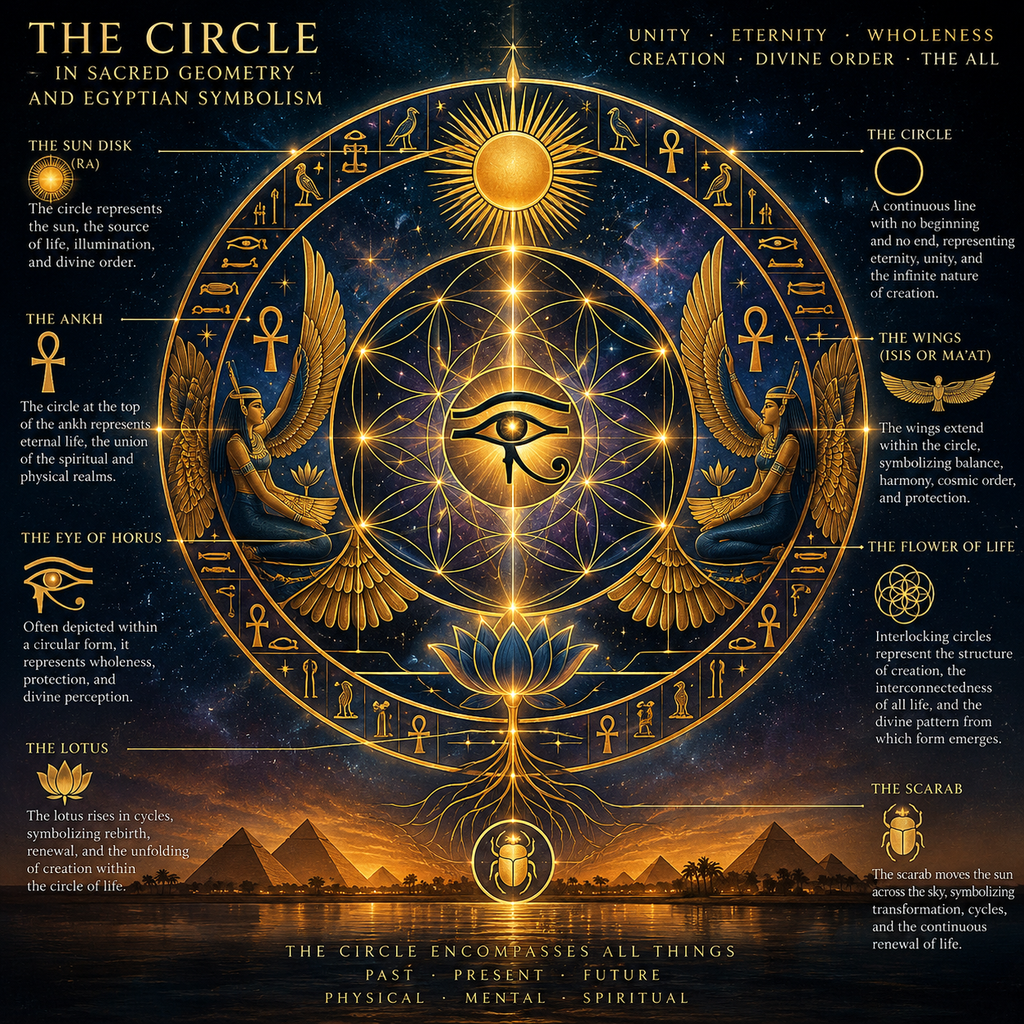
A circle is a geometric figure made up of all the points in a plane that are equally distant from a fixed center. Its circumference establishes a continuous boundary, its radius connects the center to that boundary, and its diameter passes through the center to join two points on the circumference. Along its circumference, the circle has no natural beginning or ending, and its form remains recognizable regardless of its size. These properties give us relationships we can examine.
Each of our foundational shapes adds something to the one before it. The Point establishes position. The Line introduces continuation and direction. The Circle introduces an organized relationship between a center, its boundary, and the space it encloses. Within the 18-ChakraVerse, these structures serve as developing interpretive keys: the Point reminds Adam that he occupies the present, the Line reminds him that his experience continues through time, and the Circle reminds him that his experience unfolds within an established creation.
Adam may move from one position to another, but he does not leave the conditions of creation merely by changing his location. The Circle therefore becomes a symbol of his continuing participation in the Circle of Life.
This does not mean that Adam’s spiritual existence possesses a literal geometric circumference. Rather, we use observable geometry to investigate relationships that may help us understand the spiritual principles expressed in Scripture. The geometry is the model; Scripture remains the text we are seeking to understand.
II. The Circle in Scripture
Several biblical passages employ circular imagery when describing the Creator’s ordering of the world. Isaiah 40:22 describes God as sitting above the circle of the earth, emphasizing the Creator’s greatness and the limited perspective of those who inhabit creation. Proverbs 8:27 presents personified Wisdom as present when God established the heavens and marked a circle upon the face of the deep. Job 26:10 describes God marking a boundary upon the waters, where light and darkness meet.
These passages share Hebrew vocabulary associated with circles, circular boundaries, or vaults: Isaiah 40:22 and Proverbs 8:27 use ḥûg, while Job 26:10 employs a related verbal form. Their purposes are not identical. Isaiah emphasizes divine sovereignty, Proverbs presents Wisdom in relation to creation, and Job describes God’s power through the ordering of natural boundaries. Yet they share one important feature: the ordering of creation is attributed to God. Adam is not presented as the originator of these conditions.
Other passages broaden the imagery. Job 22:14 refers to the vault of heaven, although that statement occurs within a speech by Eliphaz and must be understood in its context. Psalm 19:6 describes the sun’s circuit using different Hebrew terminology. Together these passages enlarge the picture of an ordered creation without establishing a single technical system of sacred geometry.
For our research, the interpretive value lies in the distinction between the Creator and the participant. God establishes creation, and Adam enters it. God establishes its governing conditions, and Adam discovers them. God sets creation in motion, and Adam learns to participate in what is already moving. The Circle helps us examine this relationship.
III. God Was Here Before Adam
Consider the relationship between a parent and a child. A parent exists before the child arrives and prepares for the child’s life, anticipating needs the child cannot yet recognize. Food, clothing, shelter, protection, and countless other provisions may be arranged long before the child has any awareness of them.
When the child is born, the child does not understand the environment that has been prepared. The child does not know how the household functions, how food reaches the table, or how many decisions have already been made on the child’s behalf. Yet the child benefits from all of those provisions. As the child develops, the parent continues to provide care through each stage of vulnerability, and the child gradually learns to walk, communicate, make decisions, and participate more independently in the world.
Eventually, the parent may watch the child navigate circumstances without constant instruction. But independence does not mean the parent has ceased caring, nor does the child’s growing knowledge mean the child now understands everything the parent knows. There may be events, preparations, sacrifices, and decisions the child never becomes aware of.
This familiar relationship gives us a model for examining Adam’s relationship with the Creator. God existed before Adam. God prepared the environment in which Adam would develop, and God knows Adam’s construction, capacities, and limitations in ways Adam does not fully understand. Adam enters creation without complete awareness of his origin or of the provisions already established for his development. The Creator’s knowledge precedes Adam’s awareness, His provision precedes Adam’s understanding, and His care does not depend upon Adam recognizing it.
The analogy has its limits. A human parent is also learning within creation, while the Creator is the source of its governing design. Nevertheless, the relationship helps us see how provision can precede awareness, and how increasing independence can coexist with continuing care.
IV. The Garden Was Already Growing
Genesis 2:8–15 provides a particularly important foundation for understanding Adam’s relationship with creation. God plants a garden and places Adam within it. Adam does not originate the garden; he enters an environment that already possesses the conditions necessary for life. The soil supports growth, plants possess reproductive capacities, water sustains living organisms, and the whole garden operates through relationships and processes Adam did not invent.
God places Adam there to cultivate and keep it. The Hebrew verbs commonly translated as working and keeping the garden, ʿābad and šāmar, carry the senses of serving or working and guarding or keeping. These responsibilities require participation, attention, and care. Adam is not instructed to create the laws of growth; he is given the opportunity to work within them.
A gardener cannot manufacture a seed’s fundamental capacity to become a plant. He can prepare the soil, provide water, select appropriate conditions, and protect developing growth. He can study the seasons and learn from experience. But he cannot command every seed to germinate or guarantee every harvest, because the garden operates according to conditions larger than the gardener’s intentions.
The garden also does not stop growing when the gardener stops working. Vegetation keeps spreading, organisms keep interacting, and ecological relationships keep developing. The resulting environment may differ from what the gardener intended, but growth itself does not cease. Wild growth is not automatically destructive; it demonstrates that life possesses capacities that do not depend upon Adam’s conscious direction.
This is an important lesson. Adam enters a living creation, and his responsibility is to learn how to participate in its functioning.
V. The Cube and the Education of Consequence
The Circle and the Cube serve different purposes within our developing sacred geometry framework. The Circle introduces Adam’s position within creation and the necessity of understanding where he is. The Cube represents the structured physical environment in which Adam constructs, experiences consequences, and develops his capacities. The Circle is assigned to the Root Chakra; the Cube is assigned to the Crown Chakra. We must preserve these distinctions even as we examine how their lessons interact.
Adam cannot understand rootedness without recognizing the conditions under which he lives, and those conditions belong to the larger physical classroom represented by the Cube. The Cube is not designed to explain the spiritual realm. It provides an environment in which Adam can create and learn from consequence.
Within the Cube, Adam encounters circumstances, makes choices, constructs arrangements, and observes results. He may act without understanding all the variables involved. He may pursue one outcome and discover that his construction produces something entirely different, or encounter conditions that challenge everything he expected. The Cube does not ordinarily explain why events unfold as they do; it simply continues functioning according to its established design. Consequence is the teacher.
This does not mean that every consequence is punishment. A storm need not be divine judgment, a failed harvest does not necessarily indicate spiritual misalignment, and an unexpected success does not establish divine approval. Consequences reveal something about the interaction between actions and conditions, but they do not automatically disclose every cause or the Creator’s intentions. Adam must learn to distinguish what he can observe from what he merely assumes, and this discernment is part of becoming rooted in understanding.
VI. Adam Wanted to Learn for Himself
Genesis 3 presents Adam and Eve encountering a choice concerning the tree of the knowledge of good and evil. The narrative associates the tree with knowledge, with wisdom, and with the possibility of becoming like God in knowing good and evil. Within our interpretive framework, Adam’s actions can be read as an attempt to acquire wisdom through a means other than the instruction he had already been given. He wanted to learn for himself.
Yet the consequences reveal that he did not fully understand what his choice would involve. The account describes a transition from expectation to experience: Adam acts, consequences follow, and his understanding changes. This pattern becomes significant throughout the biblical narrative. Again and again, Adam makes choices, pursues desires, constructs arrangements, and encounters outcomes that challenge his expectations.
Through these encounters he discovers that wanting something does not mean understanding everything involved in obtaining it. He also discovers that acting independently does not free him from the governing conditions of creation. The Cube provides the environment in which this education unfolds. Adam may learn through experience rather than receiving explanations in advance, and he may be required to examine consequences without knowing every factor that produced them. This is a demanding education, and it continues throughout his embodied life.
VII. The Cube Is Relentless
Adam may develop an intense desire to understand his spiritual origin. He may study Scripture, contemplate God, investigate the nature of consciousness, or seek to understand the relationship between his Inner Kingdom and the Creator. Yet the physical classroom continues. His body requires nourishment and sleep. He must protect himself from environmental conditions and respond to illness, aging, and the ordinary demands of physical existence. Even a person who withdraws into seclusion cannot escape these responsibilities, because a simple life still requires maintenance.
The Cube does not distinguish between the Adam who is pursuing wealth, the Adam who is raising children, and the Adam who is living in contemplation. Their circumstances differ, but the governing conditions remain in operation for each of them. This does not mean that every moment must be filled with deliberate activity. Rest, contemplation, and inactivity are also forms of participation within physical conditions. But none of them suspends the laws of creation, and Adam remains within the classroom.
The Circle reminds him of that reality. He may seek knowledge beyond what the Cube teaches, but he must conduct that investigation while living within it. Spiritual inquiry does not suspend physical responsibility, and physical responsibility does not eliminate the possibility of spiritual inquiry. Adam must learn to accommodate both.
VIII. To Know Myself Is to Know God
Adam is of God. Within our theological framework, his spiritual identity precedes his physical experience. Yet Adam enters the Cube with limited conscious awareness of that identity. He becomes familiar with the body, the physical environment, and the circumstances of everyday life. He learns to navigate society, establish relationships, acquire resources, and respond to physical conditions, and over time he may become highly skilled at living within the Cube. But competence within physical creation does not necessarily produce knowledge of his spiritual origin.
This requires us to distinguish three dimensions of self-knowledge. The first concerns the body: Adam learns its needs, capacities, limitations, and relationship to the physical environment. The second concerns the Inner Kingdom: Adam examines his personas, habits, desires, intentions, reactions, and patterns of construction. The third concerns his spiritual identity: Adam seeks to understand his origin, his relationship to the Creator, and the nature of the life that animates his existence. These dimensions are related, but they are not identical.
The Cube provides extensive opportunities to investigate the body and the consequences of Adam’s constructions, but it does not, by itself, disclose the complete nature of his spiritual origin. This is why Adam’s desire to know himself becomes a distinct pursuit.
To know myself is to know God. This does not mean Adam becomes God or possesses the Creator’s complete knowledge. It means that investigating his own spiritual identity is also an avenue toward understanding the One from whom he originates. Adam may discover more about himself without ever exhausting the mystery of his origin, and while he pursues that understanding, the Cube continues its lessons.
IX. Control Is an Illusion
God has set creation in motion, and Adam cannot control all the conditions under which his life unfolds. He cannot guarantee the weather, the actions of other people, the functioning of his body, or the outcomes of his decisions. Even within his Inner Kingdom, he cannot guarantee that every construction will develop exactly as intended. What he can exercise is a measure of guidance according to circumstance, and that distinction is essential.
The gardener can prepare the soil but cannot command the harvest. The parent can provide instruction but cannot determine every choice the child will make. In the same way, Adam can construct personas, establish intentions, and guide his actions, but he cannot determine every consequence that follows. His responsibility is not absolute control; it is to develop understanding sufficient to guide his participation.
This requires observation, discernment, adjustment, and continued learning. It also requires humility concerning what he does not know. The Creator’s design remains in operation whether Adam understands it or not. Adam’s growing mastery does not place him above that design; it develops his capacity to cooperate with it.
X. The Inner Garden Never Stops Growing
Adam possesses the capacity to construct personas and develop patterns of behavior. Experiences, desires, reactions, repeated choices, and intentions all contribute to the development of his Inner Kingdom, and this construction does not always occur consciously. Adam may develop protective personas in response to difficult experiences. He may establish habits through repetition. He may construct ways of navigating relationships that eventually become deeply familiar.
Some of these patterns are beneficial, while others may become misaligned. A persona originally constructed for protection may eventually interfere with cooperation. A pattern that helped Adam survive one circumstance may become harmful when conditions change. The inner garden, like the physical garden, continues developing whether Adam is tending it or not.
Genesis 3:17–18 introduces the imagery of thorns and thistles. Within our interpretation, these provide a useful model for examining undesirable growth within Adam’s Inner Kingdom. A gardener who encounters invasive growth must do more than observe what appears above the soil; he must examine the conditions supporting it. Similarly, Adam must investigate the experiences, desires, and repeated choices that sustain his personas.
In doing so, he may discover that a misaligned construction can be corrected or repurposed. Other constructions may need to be dissolved, with their energy redirected toward more beneficial purposes. The goal is not to eliminate every unexpected development, but to cultivate an Inner Kingdom capable of functioning sustainably. Adam’s inner garden will grow. His responsibility is to learn how to guide what grows.
XI. The Blueprint and Sustainable Construction
God has provided Adam with a functioning creation, and the garden demonstrates relationships Adam can observe. Growth requires appropriate conditions. Living systems depend upon interactions among their components. Boundaries influence development. Cycles of growth, decay, and renewal operate according to established processes. Adam does not need to control every one of these processes to participate beneficially; he needs to understand enough to cooperate with the conditions that sustain life.
This becomes an important model for the Inner Kingdom, because Adam’s personas must function within a larger whole. A construction that benefits one part of the Inner Kingdom while undermining the rest may not be sustainable. A protective persona that continually produces hostility may eventually damage the very relationships necessary for cooperation. A desire that repeatedly overrides judgment may undermine the conditions needed to fulfill Adam’s longer-term purpose. The question is not merely whether a construction accomplishes an immediate objective, but whether it functions beneficially within the larger system.
The biblical concept of tov, commonly translated as “good,” provides an important point of investigation. In our framework, we examine goodness through the lens of proper and beneficial functioning, while recognizing that the Hebrew word carries a broader range of meanings. This lens invites a series of questions about any construction: Does it serve its intended purpose? What fruit does it produce? What conditions sustain it? Does it contribute to the functioning of the whole?
These questions connect the Circle to the practical work of manifestation. Adam is already constructing through his intentions, words, actions, and repeated choices, and consequence provides evidence of how those constructions function. The Root Chakra teaches him to become grounded in an understanding of the conditions necessary for sustainable development.
XII. The Creator’s Blueprint and Spiritual Guidance
Adam can examine creation and learn from its structures, relationships, and consequences, but the blueprint does not provide a complete explanation of God’s plan. A parent may prepare for a child’s development without explaining every decision made on the child’s behalf, and the child benefits from knowledge and preparation that remain beyond the child’s awareness. Likewise, Adam does not possess the Creator’s complete perspective. He may never know why certain conditions were established or how particular experiences fit into a larger purpose.
This does not prevent him from learning, nor does it prevent him from seeking greater guidance. Adam is already of God. Cultivating a conscious relationship with the Creator does not establish his spiritual origin; it develops his awareness of that relationship.
Within the biblical narratives, divine communication is described through various means, including dreams, visions, prophetic messages, and direct instruction. Such communication does not always conform to ordinary expectations. Because Adam has learned to navigate the Cube through physical experience, guidance that runs contrary to his familiar reasoning may be difficult to recognize, interpret, or follow. The pursuit of spiritual understanding therefore requires discernment as well as willingness. And even when Adam believes he has received direction, he may encounter opposition.
XIII. Obedience, Opposition, and Love
Following an instruction may appear straightforward when circumstances support it. The challenge grows when obedience conflicts with insecurity, with familiar expectations, or with the opposition of family, friends, and society. Adam may believe he understands the direction he should follow while simultaneously experiencing fear, uncertainty, or pressure to abandon it. Protective personas may become active as he worries about rejection, loss, embarrassment, or failure. In these moments, the Inner Kingdom reveals the extent to which its constructions can cooperate under pressure.
The biblical narratives repeatedly examine this tension. Abraham leaves familiar surroundings. Moses confronts an assignment he initially questions his capacity to fulfill. Jeremiah protests his youth when called to speak. These accounts give us opportunities to examine the relationship between instruction, human limitation, and action.
But obedience introduces another challenge: how will Adam respond to those who oppose him? In Matthew 5:44, Jesus instructs his listeners to love their enemies and pray for those who persecute them. This instruction becomes particularly demanding when opposition comes from people whose approval or cooperation Adam values. He may be tempted to construct resentment, bitterness, or hostility in response, yet these constructions can redirect his attention away from the very purpose he intended to pursue.
There is another possibility. Adam can remain focused upon the assignment he understands himself to have received, keeping his attention on purposeful action rather than on defeating those who oppose him. This does not require him to approve of harmful behavior or surrender appropriate boundaries. It requires him to avoid making opposition the governing principle of his Inner Kingdom.
Within our High Heart framework, metaphysical love is distinguished from fleeting emotion. Feelings may fluctuate under pressure, but commitment to alignment need not fluctuate with them. By continuing to cultivate purposeful action, Adam may avoid creating the conditions in which resentment becomes established. This is another application of the garden principle: Adam cannot control every circumstance or emotional response, but he can guide what he chooses to cultivate.
XIV. Rootedness Is Understanding
A tree’s roots establish relationships with the conditions that sustain its growth. They provide anchorage and enable the plant to draw water and nutrients from its environment. They do not prevent the wind from blowing, stop the seasons from changing, or give the tree authority over its environment. What they do is establish the conditions through which the tree can remain supported while the environment changes. This provides a useful model for spiritual rootedness.
Adam is already within creation, but being within creation is not the same as understanding it. He must learn where he is, whose design he inhabits, and what conditions support sustainable construction. He must recognize that the Cube belongs to the Creator. He must understand that he is of God, yet that his physical environment does not provide complete knowledge of his spiritual identity. He must accept that his responsibility is guidance rather than absolute control, and he must learn to sustain his Inner Kingdom according to the principles he discovers.
Rootedness is therefore more than attachment to a location, a family, a culture, or a familiar way of life, all of which may change. Rootedness is Adam’s developing understanding of the Creator’s design and his capacity to remain oriented within it. The rooted Adam does not require the environment to remain unchanged. He learns to recognize where he is and to respond according to the conditions he encounters. This is the Root Chakra’s foundational responsibility.
XV. Mastery Is Calm Within Chaos
Mastery is not the ability to guarantee a desired outcome. It is not control over the environment, and it is not complete knowledge of God’s plan. Mastery is calm within chaos.
Adam may encounter circumstances that appear confusing, painful, or contrary to his expectations, and he may not understand why events unfold as they do. But within our theological framework, Adam can develop confidence in the Creator’s design, a confidence that does not depend upon every circumstance becoming favorable. A difficult consequence may still contribute to understanding. An unexpected detour may reveal a weakness in Adam’s construction. Opposition may expose the condition of his Inner Kingdom. The outcome Adam initially desired is not necessarily the outcome that best serves his development.
As his understanding matures, Adam becomes less dependent upon favorable circumstances to maintain his orientation. He learns to guide his actions according to the blueprint rather than according to every change in the environment.
This connects the Root Chakra to the later development of the Stellar Gateway. At the Root, Adam begins understanding the foundation. At the Stellar Gateway, his developed capacities are tested under the demands of purpose. Preparation develops capacities, pressure reveals their cooperation, and action demonstrates mastery. The Root establishes the foundation upon which that later demonstration becomes possible.
XVI. When Adam Ignores the Blueprint
The laws of creation do not change because Adam fails to understand them. A gardener who ignores the conditions necessary for growth may experience a failed harvest, but that failure does not mean the laws of growth have stopped functioning. It means the gardener’s construction did not adequately cooperate with those laws.
Similarly, Adam may construct personas or pursue desires that undermine the functioning of his Inner Kingdom. Immediate gratification may conceal long-term deterioration, and a construction may appear successful while damaging the very conditions upon which its continued functioning depends. Consequence can reveal the problem. Adam can then examine the evidence, reconsider his methods, and cultivate differently.
This does not mean every hardship indicates misalignment. Adam’s circumstances include conditions beyond his jurisdiction, and he cannot determine the complete causes or purposes of every event. The important question is what he can learn from the consequences of his own participation. The blueprint does not change because Adam ignores it; his responsibility is to keep developing the understanding necessary to construct according to it.
XVII. Build a Garden Like the One You Live In
The Creator prepared the garden before Adam entered it. Its laws were established before Adam understood them, and its capacity to sustain life did not originate with him. Adam entered creation with limited awareness, much as a child enters a household prepared by a parent. He has benefited from provisions he did not recognize and encountered conditions he did not establish. He has learned through action and consequence. He has constructed personas, developed capacities, made mistakes, and discovered that his intentions do not determine every outcome.
Throughout this education, the Cube has continued functioning. It does not stop because Adam wishes to understand the spiritual realm. His body continues requiring attention, his circumstances continue changing, and his responsibilities remain. He must learn to accommodate the demands of physical existence while pursuing knowledge of his spiritual origin.
The Circle reminds him that he is always here. The Point establishes his present position, the Line continues his experience, and the Circle places that experience within the continuing conditions of creation. The Root Chakra teaches him to understand those conditions well enough to construct sustainably.
Adam cannot control the garden, but he can learn to cultivate it. He cannot possess the Creator’s complete knowledge, but he can seek greater understanding. He cannot escape every difficult circumstance, but he can develop the capacity to remain oriented within them. And he cannot discover who he is by forgetting where he is.
Conclusion — Rooted in the Circle of Life
You are always here, within the Circle of Life. The garden was growing before you arrived. Its laws were established before you understood them, and its capacity to sustain life does not originate with you. You entered a creation already prepared for your development. You have been sustained by provisions you did not recognize, you have encountered circumstances you could not control, and you have learned through consequences you did not always anticipate. And still, there is more to discover.
You are of God, and to know yourself is to seek a deeper understanding of your Creator. But the Cube continues. The body requires care, the environment changes, and responsibilities demand attention. Every day provides another opportunity to construct, observe, and learn. You cannot suspend physical existence while you investigate spiritual existence; you must learn to do both.
So examine the garden in which you live. Study its relationships, discover what sustains it, and recognize what causes it to deteriorate. Then examine the garden within yourself. What have you cultivated? What has grown without your attention? What fruit are your constructions producing, and what conditions must be corrected? You cannot control everything that grows, but you can develop understanding and guide your cultivation.
And when circumstances become chaotic, remember where you are. You remain within the Creator’s design. Mastery is calm within chaos.
Adam seeks to know who he is without forgetting where he is. Build a garden like the one you live in.