
From Soil to Roots — The Foundation of Self-Government
The 18-ChakraVerse | Inherited Chakra 2
By Iris J Chapman
Sacred Geometry: The Circle
Creation Day: Day Two — The Firmament
Zodiac: Aries — I AM
Element: Earth
Eve Correspondence: Spirit of YHWH / Holy Spirit
Office: The Circle of Life
Core Teaching: Adam’s jurisdiction is his inner kingdom.
Developmental Responsibility: Establishing the foundations of self-government in preparation for co-rulership and co-creation.
From Soil to Roots
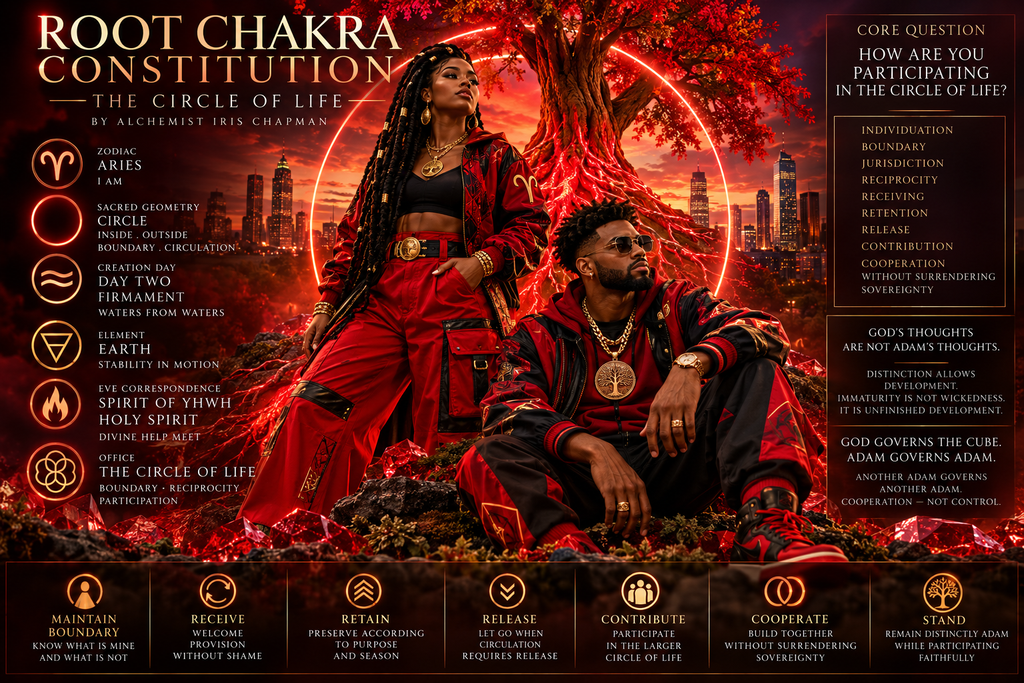
The Earth Star Chakra asks a searching question: Where are you? The Root Chakra follows with another: How are you participating in the Circle of Life? If Earth Star is the soil, Root is the roots. The condition of the soil matters because roots must grow somewhere, but roots are not passive. They receive nourishment, establish stability, exchange resources, and contribute to the environment that sustains them. In this way, they change the soil even as the soil shapes them.
Adam’s development follows a similar pattern. He enters a world he did not create, governed by laws he did not establish, and surrounded by circumstances he cannot completely control. Yet within that world, he possesses something of extraordinary importance: an inner kingdom entrusted to his government. This is the foundation of the Root Chakra. Adam has been given a body, an inner kingdom, and the capacity to construct the personas through which he will experience life. He has also been given Eve, his spiritual Helpmeet, whose capacities assist him in recognizing and constructing what is good.
Adam’s education is designed to prepare him to become a responsible co-ruler and co-creator alongside the Creator. To accomplish this, he must cultivate his king/priest and priest/king qualities, learning to govern his inner kingdom while developing and maintaining a conscious relationship with God. The Cube provides the classroom, experience provides the opportunities to learn, and consequence becomes the teacher.
But before Adam can master the responsibilities of government, he must understand where his authority begins and where it ends. God governs the Cube. Adam governs Adam. This distinction is the foundation upon which the rest of Adam’s education will be built.
The Sacred Geometry of the Circle
From the Point and Line to the Circle
At Earth Star, sacred geometry begins with the Point and the Line. The Point establishes Adam’s existence, and the Line represents his continuation through experience and development. At Root, the Line bends around and meets itself, forming a Circle. That closing of the Line creates a fundamental distinction, an inside and an outside, and that simple distinction is what makes government possible.
Before Adam can govern Adam, he must recognize who Adam is. He is not another Adam. He is not the world surrounding him, nor is he the conditions of the Cube. He is not even the personas he will construct and employ throughout his journey. He is the one responsible for governing his inner kingdom, and the Circle establishes that jurisdiction.
The Circle Is Not a Prison
A boundary does not necessarily mean isolation. Consider a living cell: its membrane distinguishes what belongs inside from what exists outside, yet the cell must constantly exchange resources with its environment to remain alive. The Circle functions in a similar way as a symbol of Adam’s individual jurisdiction. It establishes distinction without requiring separation from life.
Adam can receive information, exchange ideas, form relationships, cooperate with others, and participate in the larger creation without surrendering his individuality. What enters his awareness may influence him, but influence is not government. Adam remains responsible for determining what he will accept, cultivate, revise, or release within his kingdom. The Cube can present circumstances, but it cannot become Adam.
The Circle Remains
One of the most important features of the Circle is its permanence throughout Adam’s education. He will progress through the chakras, construct personas, experience consequences, develop discernment, learn reconciliation, and cultivate the capacities necessary for balanced rulership. His understanding will change, his abilities will develop, and his responsibilities may increase. Yet his jurisdiction remains his inner kingdom.
Even when Adam achieves the maturity necessary for co-rulership and co-creation, he does not become the Creator. He remains a creation working alongside the Creator. The Circle establishes the territory. Adam must learn to govern it.
Aries — I AM: The Recognition of Self
The zodiac correspondence of Root is Aries, whose central declaration is I AM. Adam already exists before he reaches Root, so Aries does not represent his creation. It represents his growing recognition of himself as an individual.
During childhood, much of Adam’s environment is organized by others. Family, caregivers, culture, and society provide the structures within which he develops. This dependence serves an important purpose, because an immature Adam does not yet possess the experience necessary for independent government. But childhood cannot remain the permanent condition of his development. As Adam matures, he must begin recognizing the difference between what others provide and what he himself chooses. He must learn to think, evaluate, and decide, and he must learn to accept the consequences of his decisions.
The declaration I AM establishes the beginning of that recognition: I am Adam. I possess an inner kingdom. I am responsible for what I construct within it.
Puberty and a New Season
Within the 18-ChakraVerse, puberty marks an important developmental transition. Adam moves toward a season in which independent government becomes increasingly necessary. He is not suddenly mature; rather, he is beginning a new stage of education. This is also the stage at which Eve comes online. Adam is preparing for his journey through the Cube, and the Creator has provided him with a Helpmeet equipped for the responsibilities ahead.
Independence Is Not Separation from God
Adam is of God, and his capacity for independent thought does not sever that relationship. Instead, it makes a conscious relationship possible. Adam must eventually understand God for himself. He cannot become a responsible co-creator by remaining entirely dependent upon another person’s understanding. He must develop discernment, recognize divine principles, and learn how to apply them, and this requires the freedom to think, question, choose, experience, and learn.
It also requires recognizing that his understanding may be incomplete. Adam can be mistaken without being inherently wicked, and he can be immature without being condemned. Immaturity is simply unfinished development. The Cube provides the conditions in which Adam can discover the difference between what he believes, what he constructs, and what his constructions actually produce.
Eve — The Spirit of YHWH and Adam’s Helpmeet
At Root, Eve corresponds to the Spirit of YHWH, the Holy Spirit. Adam does not construct Eve. She is provided by the Creator as Adam’s spiritual Helpmeet, and she comes equipped with the Seven Capacities. Her assignment is to assist Adam in recognizing and constructing what is good, which means Adam’s journey is never undertaken alone.
The Marriage Within
The marriage of Adam and Eve is a spiritual marriage. It is not the union of two separate human beings, nor does it require one Adam to surrender an inner kingdom to another. Every Adam possesses individual jurisdiction. Eve is the spiritual Helpmeet provided to Adam, and their union establishes the partnership through which Adam can develop his creative capacities.
This relationship becomes fundamental to his education. Adam must learn not only to construct, but to understand what he constructs, why he constructs it, and whether it serves a good purpose. Eve assists him in that development.
The Commission to Be Fruitful
Genesis 1:28 introduces the commission to be fruitful and multiply. Within the 18-ChakraVerse, fruitfulness extends beyond physical reproduction, for Eve is the mother of Adam’s personas. Together, Adam and Eve participate in constructing the personas through which Adam undertakes his endeavors. A persona may be developed for protection, learning, leadership, service, creativity, or any number of other purposes.
These constructions are not automatically aligned simply because Adam created them; their fruit reveals how they function. A persona may serve its original purpose well and later become unsuitable when circumstances change, while another may require correction, repurposing, or dissolution. Adam must learn to govern what he creates.
Root establishes the partners, their jurisdiction, and their commission. The Sacral Chakra then introduces the Vesica Piscis, the potential for balanced king/priest development through which Adam’s creative responsibilities will unfold.
Day Two — The Firmament and the Law of Distinction
In Genesis 1:6–8, God establishes a firmament that divides the waters from the waters. This is the second day of creation, and it corresponds to the Root Chakra. The movement of this day is significant: Division → Distinction → Boundary → Jurisdiction. The firmament establishes distinction, but it does not declare one body of water good and the other evil, nor does it require hostility between what has been separated. It establishes an ordered relationship, and the Circle expresses this same principle.
God’s Thoughts and Adam’s Thoughts
God’s thoughts are not Adam’s thoughts. Isaiah 55:8–9 emphasizes the distinction between divine thoughts and human thoughts. Yet distinction does not mean that every thought originating with Adam is necessarily wrong. Adam has been given the capacity to think. His understanding may be incomplete, but that is precisely why education is necessary. He must learn to recognize what is consistent with the divine blueprint and what produces disorder. The distinction between Creator and creation remains, even as Adam’s understanding becomes more aligned.
Heaven Within Adam
Within this framework, Heaven represents an internal realm of divine alignment. Adam’s relationship with God does not require him to dissolve his individuality; in fact, a mature relationship requires distinction. God remains God, and Adam remains Adam. Their relationship develops through understanding, alignment, and conscious cooperation, and through it all, the Circle remains intact.
Where Are You?
Genesis 3:9 records God asking Adam, “Where are you?” Adam responds from a condition of fear and concealment. The encounter offers an important distinction between what God communicates and what Adam concludes. God asks a question, but Adam hears that question through his developing understanding and responds according to what he believes is happening. This reveals a sequence that continues throughout Adam’s education:
- What God communicates.
- What Adam perceives.
- What Adam concludes.
- How Adam responds.
These are not necessarily identical, and Adam must learn to distinguish reality from interpretation. A question is not automatically condemnation. A limitation is not automatically rejection. A consequence is not necessarily evidence that God has abandoned Adam. The Root Chakra begins teaching Adam to recognize his own participation in what he experiences.
The Circle of Life — Receiving, Retaining, Releasing, and Contributing
The Circle establishes Adam’s jurisdiction, but it also represents his participation in life. Roots offer a useful model here. They receive nourishment from the soil, retain resources, release substances into their environment, and contribute to the conditions that sustain life. The relationship is reciprocal: Soil → Roots → Soil. Adam’s participation in the Circle of Life requires four similar functions.
Receiving
Adam must be capable of accepting what supports his development. Food, shelter, knowledge, affection, assistance, and opportunity may all contribute to his ability to function. Receiving is not weakness. A kingdom that refuses nourishment cannot remain healthy.
Retaining
Not everything Adam receives should be immediately released. Some resources must be preserved for future responsibilities, and wisdom includes recognizing what should be retained, why it is needed, and when it may be required. Retention, rightly understood, can be an act of responsible government.
Releasing
What once served a purpose may no longer be needed. Adam must learn to release what has completed its function, what has become harmful, or what obstructs his further development. This applies to resources, habits, assumptions, and personas alike. Release makes room for new construction.
Contributing
Adam does not exist outside the larger Circle of Life, and his actions affect the environment in which he participates. Contribution allows what he develops to serve purposes beyond his own immediate accumulation. But healthy contribution does not require self-destruction. The Circle must sustain life, and that includes Adam’s own.
Participate sustainably in the Circle of Life according to purpose and season.
Three Biblical Demonstrations of Circulation
The Bible provides different examples of receiving, retaining, releasing, and contributing. Taken together, these accounts reveal why the outward appearance of an action does not always establish its function.
The Rich Fool — When Circulation Stops
In Luke 12:16–21, Jesus describes a rich man whose land produces abundantly. The man decides to tear down his barns and build larger ones in which to store his goods. Receiving abundance is not the problem, and neither is possessing property or preserving resources. The problem is that his entire plan terminates in personal accumulation: receive, accumulate, retain, expand storage, and retain again. His plans make no account of the larger purpose of his life. He has confused possession with security, and the Circle has become a reservoir.
Joseph — When Retention Serves Life
Genesis 41 presents a different example. Joseph interprets Pharaoh’s dreams and prepares Egypt for seven years of famine by storing grain during the seven years of abundance. Outwardly, this also involves accumulation, but its function is entirely different. Joseph receives, preserves, and eventually releases resources when they are needed, so his retention serves a larger purpose. The distinction is important, because the same action can serve very different ends depending on understanding, intention, and circumstance.
The Widow of Zarephath — Circulation Under Scarcity
In 1 Kings 17, Elijah encounters a widow with very little food remaining. Her circumstances are difficult, yet the account describes provision continuing through her response to Elijah’s instruction. This story demonstrates circulation under conditions of scarcity. It does not establish that Adam should recklessly give away everything he needs for survival. Rather, it illustrates a relationship in which giving and receiving continue despite severe limitations.
Together, these three accounts demonstrate an important principle: the function of an action matters more than its outward appearance. Adam must develop the discernment necessary to recognize that function.
Adam’s Inner Kingdom — The Garden Within
Genesis 2:15 describes Adam being placed in the Garden of Eden to cultivate and keep it, and the garden provides a powerful model for understanding the inner kingdom. A garden does not remain cultivated simply because it was once planted; it requires ongoing attention. Seeds grow, roots spread, conditions change, and some plants flourish while others compete for resources. Neglect also produces results. A garden left unattended does not stop producing life. It simply develops according to whatever conditions and seeds are present. Adam’s inner kingdom functions in the same way.
What Adam Cultivates Will Grow
Thoughts, beliefs, habits, and personas all become part of the environment Adam constructs within himself, and repeated choices strengthen patterns. A protective persona may become increasingly effective at recognizing danger, yet if it develops without discernment, it may begin treating every unfamiliar situation as a threat. A persona developed for achievement may produce valuable results, but without balanced government, achievement may become compulsive accumulation. The original construction is not necessarily the problem. Its development and application determine its function, which is why Adam must learn to cultivate his kingdom.
The Divine Blueprint
The Creator has established laws governing creation. Adam does not need to invent those laws; he needs to understand how to work with them. The garden provides observable instruction, showing that healthy growth requires suitable conditions, appropriate nourishment, balance, and maintenance. Adam cannot sustain what he constructs without understanding the principles that support it.
This is why the Root Chakra is more than a lesson about survival. It is the foundation of sustainable government. The goal is tov, functional good. A healthy inner kingdom is one in which Adam’s constructions serve their purposes without destroying the conditions necessary for continued life and development.
Boundaries, Influence, and Self-Government
Adam lives among other Adams, each possessing an individual inner kingdom. Relationships make cooperation possible, but they do not transfer spiritual jurisdiction. Adam may persuade, request, teach, negotiate, and cooperate. He may also establish boundaries or withdraw from circumstances that are harmful. But he cannot assume government over another Adam’s inner kingdom, and likewise, another Adam cannot legitimately become the sovereign of his.
Influence Is Not Government
This distinction becomes especially important within Adam’s own consciousness. Fear may influence a decision. Anger may demand action. A persona constructed during an earlier experience may attempt to govern a situation for which it was never designed. Adam may feel pressure from his environment, his body, or his constructed personas, yet pressure is not authority. He must learn to recognize these influences and decide how they will function within his kingdom. This is the beginning of responsible self-government.
Nehemiah — Restoring the Walls
The rebuilding of Jerusalem’s walls in Nehemiah provides another useful symbol. Walls establish a recognizable boundary, while gates permit passage, so the city is neither completely exposed nor permanently sealed. Its boundaries allow organized life to continue. Adam’s inner kingdom likewise requires boundaries that permit healthy exchange while preserving individual government. The objective is not isolation. It is ordered participation.
The Foundation of King/Priest Development
The Root Chakra establishes the jurisdiction over which Adam must eventually demonstrate mastery. But possessing a kingdom does not mean Adam already knows how to govern it. His education must develop two complementary capacities.
The Kingly Responsibility
The kingly function concerns government. Adam must learn to make decisions, establish order, exercise authority over his personas, and accept responsibility for what he constructs. He must recognize when a persona is serving its purpose and when its behavior requires correction. He must also learn to govern without allowing fear, resentment, pride, or uncontrolled desire to seize the throne. The kingly responsibility is not domination; it is responsible government.
The Priestly Responsibility
The priestly function concerns Adam’s relationship with the Creator. Adam must develop an understanding of divine principles and learn to maintain alignment while exercising his independent will. He cannot merely claim to represent God. His constructions must demonstrate that he understands the principles he seeks to apply. The priestly responsibility therefore requires conscious relationship, discernment, and fidelity to the divine blueprint.
The Balance of King and Priest
These two functions must develop together. Government without alignment may become destructive, while spiritual understanding without the ability to govern one’s constructions may remain ineffective. The Vesica Piscis of the Sacral Chakra represents the potential for balanced king/priest and priest/king development, and Root establishes the jurisdiction in which this development will occur. Adam must become capable of both responsible authority and sustained alignment. This is the foundation of co-rulership and co-creation.
The Cube — Education Through Experience and Consequence
The Cube is the classroom within which Adam undertakes his education. Its laws and conditions belong to the Creator, and Adam cannot determine everything that will happen within it. What he can choose is how he will respond, and this distinction is essential. Adam may encounter abundance, scarcity, conflict, cooperation, security, danger, opportunity, or uncertainty, and the same skill may be tested under many different conditions.
Consider a person learning to drive. Driving on a clear, dry road requires certain abilities, but driving through fog, heavy traffic, black ice, or a flooded roadway requires those same abilities to function under far more demanding circumstances. The driver may also be dealing with fatigue, distraction, resentment, or anger. Mastery requires more than knowing how to operate the vehicle; it requires maintaining sound judgment as conditions change.
Adam’s education follows a similar pattern. A persona that functions effectively under peaceful conditions may become unstable under pressure, and a decision that seems reasonable in abundance may require reconsideration during scarcity. Adam must learn to apply divine principles across changing circumstances.
Consequence Is the Teacher
The Cube does not need to explain every lesson. Adam acts, and consequences follow. He observes what his constructions produce. He may misunderstand the outcome, repeat the behavior, or revise his approach, and through experience he gradually develops discernment. The classroom can present new conditions and opportunities across lifetimes, but Adam’s jurisdiction remains the same. Wherever he goes, he remains within the Circle of his own existence.
His circumstances may shape the classroom, but his choices determine what he learns.
Revelation — The Evaluation of Mastery
Adam’s education is directed toward a purpose: he is developing the capacities necessary to become a responsible co-ruler and co-creator alongside the Creator. Throughout his journey, he has learned to construct personas, govern his inner kingdom, recognize divine principles, and maintain alignment under increasingly demanding circumstances. His king/priest and priest/king qualities have been cultivated through experience.
Revelation brings this development into evaluation. The question is no longer simply whether Adam possesses the potential for responsible government. The question is what he has become through the exercise of that potential.
The Revelation of Achievement
Within the 18-ChakraVerse, Revelation reveals the outcome of Adam’s development. The personas, patterns, and constructions associated with his journey become subject to evaluation. What has served its purpose? What has become aligned? What requires repurposing? What has completed its function and may be dissolved? The evaluation concerns the results of Adam’s education.
Revelation also initiates Adam into another level of responsibility. The classroom has prepared him for something beyond the acquisition of foundational capacities, and he is now capable of demonstrating what he has mastered. Yet his relationship to the Creator remains unchanged in one essential respect. God remains the Creator, Adam remains the creation, and the Circle remains.
The New Testament — Mastery Demonstrated Through Action
The New Testament introduces a significant dimension of Adam’s development. Adam may return to the Cube, not merely to repeat the foundational curriculum, but to put into practice what he has spent lifetimes mastering. His relationship with the classroom has changed. He has developed the capacities necessary for responsible government, and now those capacities must function through action. The New Testament provides demonstrations of king/priest and priest/king qualities exercised under the demands of an assignment.
The Jesus Persona
The Gospel accounts offer a particularly important demonstration. Jesus exercises authority while maintaining his relationship with the Father, even as he encounters opposition, temptation, misunderstanding, physical suffering, and the demands of his responsibilities. His responses provide opportunities to examine how kingly authority and priestly alignment cooperate. In John 5:19, Jesus describes his actions in relationship to what he sees the Father doing, and in John 6:38, he identifies his purpose with carrying out the will of the one who sent him. These passages illuminate the relationship between independent action and divine alignment. Jesus is not presented as exercising authority in competition with the Creator; his actions demonstrate cooperation with the Creator.
Grace Under Pressure
The crucifixion provides one of the most demanding demonstrations of all. The Jesus persona is subjected to humiliation, injustice, and physical suffering, yet the Gospel accounts portray a sustained commitment to his assignment. The significance is not simply that he possesses knowledge of divine principles, but that he demonstrates their application under extraordinary pressure. This is the difference between preparation and mastery expressed through action. Adam has spent lifetimes developing the capacities necessary for balanced government, and now those capacities must cooperate when circumstances become difficult.
Co-Rulership and Co-Creation
The New Testament demonstrates what responsible participation alongside the Creator can look like. Adam’s developed authority is exercised within the jurisdiction entrusted to him, his relationship with God is conscious and established, and his actions express the capacities he has cultivated. The objective is not to become equal to the Creator. It is to become the kind of creation capable of working alongside the Creator without abandoning alignment. Adam’s education has prepared him for responsibility, and his actions demonstrate whether that preparation has become mastery.
The Circle Remains
The Root Chakra begins with a simple geometric form: a Line closes upon itself and becomes a Circle. Within that Circle, Adam discovers the boundaries of his individual jurisdiction. He learns that he is not the Cube, not another Adam, and not the personas he constructs. He is the one responsible for governing his inner kingdom, and Eve, his spiritual Helpmeet, assists him in recognizing and constructing what is good.
The Cube provides the conditions for his education. Experience introduces challenges, and consequence reveals the effects of his choices. Through this education, Adam cultivates the king/priest and priest/king qualities necessary for responsible co-rulership and co-creation. Revelation evaluates his development and initiates him into another level, and the New Testament demonstrates the exercise of that mastery through action.
Yet the foundation never changes. God governs the Cube. Adam governs Adam. Adam does not become a co-ruler by expanding his jurisdiction over others. He becomes capable of co-rulership by mastering the government of the kingdom already entrusted to him. The Circle does not need to become something else; Adam must become capable of governing what the Circle contains.
And wherever his journey takes him, one truth remains: The Circle remains. Adam develops. The Creator’s laws endure.
The Circle establishes Adam’s jurisdiction. The Cube provides the classroom. Experience develops understanding. Consequence teaches. Mastery prepares Adam for co-rulership. And through every stage of his development, the Circle remains.
The 18-ChakraVerse — From Unconscious Construction to Conscious Construction
Iris J Chapman