
The Potential for King–Priest Development
Sacred Geometry of Life
By Iris J Chapman
Two Circles, One Adam
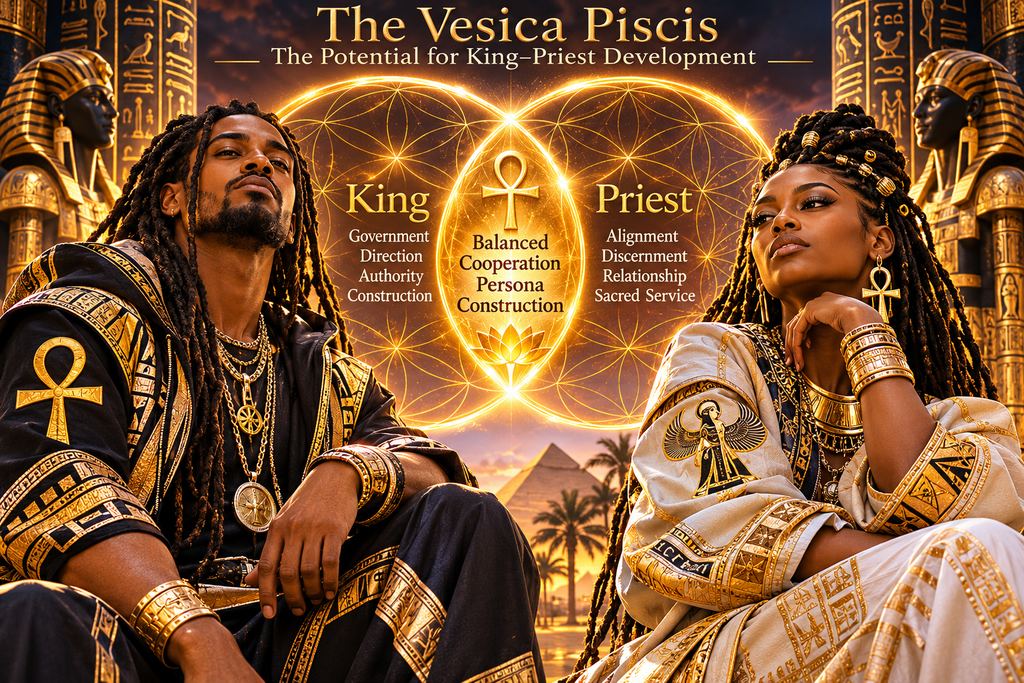
The Vesica Piscis is one of the simplest forms in sacred geometry. Two circles of equal size overlap, and in doing so they create a shared space between them. Each circle keeps its own center, and neither loses its identity in the meeting. Yet their intersection produces something that neither circle possesses on its own. Within the Sacred Geometry of Life, this simple relationship points to a profound potential written into Adam’s original construction: the development of King and Priest.
Where the Circle established Adam’s wholeness, the Vesica Piscis introduces differentiation within that wholeness. Adam remains one, but he carries complementary capacities that must learn to cooperate. One capacity governs, while the other maintains alignment with the Creator. Together they provide the potential for purposeful construction, the ability to build what is both intended and good.
It is important to be clear about what the geometry represents. It is not a picture of a completed achievement. It is a picture of something Adam was constructed with the capacity to develop. The potential was present from the beginning, but its mature expression must be learned.
Male and Female — The Original Construction
Genesis 1:27 states:
“So God created man in his own image, in the image of God he created him; male and female he created them.”
This passage places male and female within the original construction of humanity. In the Sacred Geometry of Life, Adam represents corporate humanity rather than a single male body. Masculine and feminine potentials belong to Adam’s spiritual construction from the start. They are not capacities Adam acquires because he happens to inhabit a particular physical sex.
Adam possesses the potential to incarnate as either male or female, and each physical expression offers different conditions for experience, observation, and development. A male body does not make Adam exclusively masculine in spiritual capacity, and a female body does not make Adam exclusively feminine. Both carry the Vesica Piscis, and both carry the potential to develop King and Priest. This distinction matters because the purpose of the geometry is not to divide humanity into two competing categories. Its purpose is to illustrate complementary capacities that live within one spiritual construction.
One further clarification keeps the picture clean. Eve, Adam’s helpmeet and manifesting capacity, is distinct from the feminine potential represented in the geometry. The feminine circle corresponds to the Priest capacity, while Eve is the one who participates in bringing Adam’s intentions into expression. The two are related within Adam’s construction, but they are not interchangeable.
The Body Demonstrates the Principle
We cannot directly observe the spiritual construction of Adam, but we can examine the physical creation in which Adam learns. A human organism begins as a single fertilized egg. Through cellular division and differentiation, that one beginning develops into an increasingly complex organism. Along the way the body develops two sides, yet it remains one body.
The two sides are not perfectly identical. One hand may be slightly larger than the other, one foot may differ a little in size, and one eye may sit at a different angle or carry a different shape. One side may become dominant for particular activities. Yet none of these differences divide the person into two separate beings. Both sides belong to one organism, each contributes according to its function, and their cooperation supports the whole.
This gives us an observable illustration of the principle the Vesica Piscis represents. Differentiation does not require separation, and balance does not require sameness. The purpose of complementary capacities is not to make them identical but to enable them to function together. The same principle can now be examined in Adam’s development of King and Priest.
King and Priest — Two Complementary Capacities
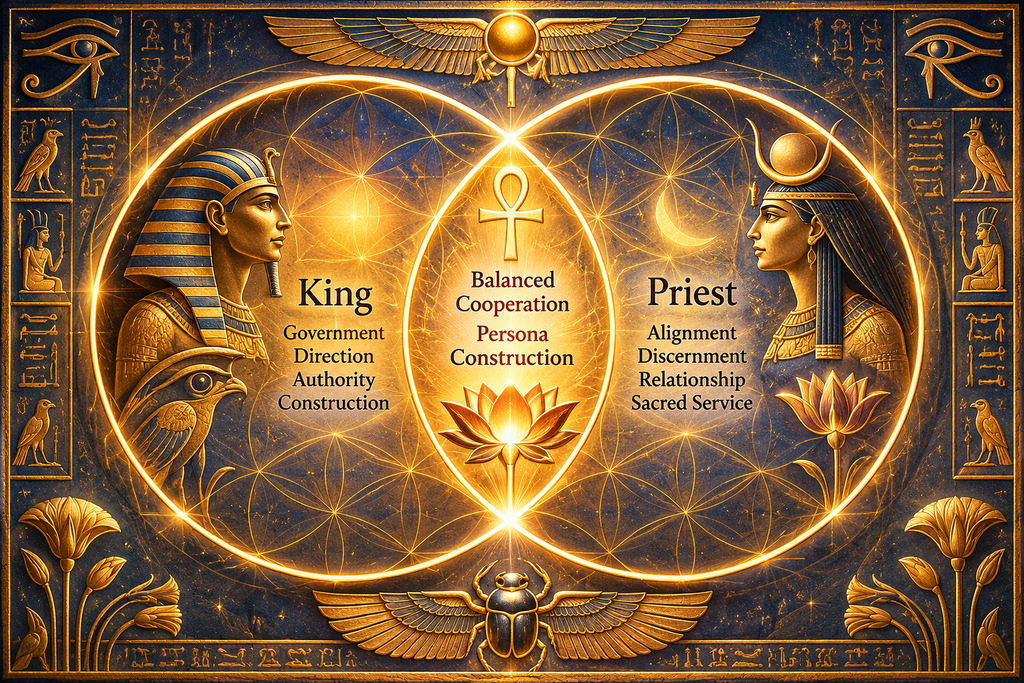
Within the Vesica Piscis, the masculine potential corresponds to King development and the feminine potential corresponds to Priest development. King represents the capacity for government. It concerns direction, decision-making, responsibility, authority, and the ability to construct. King determines what is to be accomplished and governs the actions needed to accomplish it.
Priest represents the capacity for relationship and alignment with the Creator. It concerns discernment, understanding, spiritual responsibility, and the recognition of the laws and purposes within which all construction must take place. Where King asks “What shall we build, and how?”, Priest asks “Is this in keeping with the Creator’s blueprint?”
Neither capacity is sufficient on its own for sustainable government. A King may have determination, authority, and the ability to reach a goal without adequately considering whether that goal is beneficial. A Priest may have understanding and discernment yet lack the governing capacity needed to put that understanding into action. Adam needs both. Government provides direction, and alignment provides the standard by which that direction is evaluated.
The aim is not for King to become Priest or for Priest to become King. Each retains its distinct function. It is their cooperation that makes purposeful government possible.
The Capacities Are Not Restricted by Physical Sex
The Bible offers numerous examples of men and women exercising governing and spiritual responsibilities. David and Solomon held the formal office of king. Deborah exercised judicial authority and led Israel. Esther used her royal position to protect her people. Athaliah ruled Judah, a sobering reminder that governing authority can also be exercised destructively. The titles differ from one account to the next, but the underlying capacity for government is recognizable in each.
The same principle appears in spiritual responsibility. Aaron served as priest. Samuel carried prophetic responsibility, instructed Israel, and performed sacrificial duties. Miriam was identified as a prophetess, and Huldah was consulted concerning God’s law. Anna devoted herself to worship, prayer, and proclamation, while Priscilla took part in instructing Apollos. These individuals did not all hold the same formal office, yet their accounts reveal responsibilities involving discernment, spiritual instruction, service, and relationship with God.
This is why the distinction between title and capacity matters. A woman need not hold the formal title of priest to demonstrate spiritual discernment, and a man need not hold the formal title of king to exercise governing responsibility. In the same way, a male incarnation does not prevent Adam from developing the Priest capacity, and a female incarnation does not prevent Adam from developing the King capacity. King and Priest belong to Adam’s potential, not to the sex of Adam’s physical body. The biblical accounts simply show these capacities at work under different circumstances and different titles.
Melchizedek — King and Priest in One
Genesis 14:18 introduces Melchizedek as King of Salem and Priest of God Most High, and this makes him a particularly significant biblical correspondence for the Vesica Piscis. Melchizedek is not presented as one person exercising government while another provides priestly service. Both offices are united within one figure. Psalm 110:4 later speaks of the order of Melchizedek, and Hebrews 7 develops the meaning of that priesthood at length.
The relationship becomes especially important in the presentation of Jesus. Hebrews 5–7 connects Jesus with the priesthood of Melchizedek, and in Him authority and spiritual responsibility are not competing functions. His governing purpose operates in relationship with obedience to the Creator. The Wedding at Cana offers an illustration of developed capacities becoming visible through action. Jesus did not become prepared at Cana; the event revealed a development that had already taken place. His actions showed the cooperation of capacities sufficient for the responsibility in front of Him. Development preceded demonstration.
The King–Priest relationship also reaches beyond Melchizedek and Jesus as individual figures. Revelation 1:6 describes Christ’s followers as a kingdom and priests to God, and 1 Peter 2:9 uses the expression “royal priesthood.” These passages bring royal and priestly language together to describe a collective spiritual responsibility. The Vesica Piscis provides a simple geometric illustration of the potential for that union: Adam possesses both capacities, and their mature cooperation must be developed.
The Shared Space — Where Balanced Construction Becomes Possible
The most interesting feature of the Vesica Piscis may be the space created where the two circles overlap. The circles do not disappear into one another; each keeps its own center and its own region. Yet a shared region exists precisely because both are present. This intersection may represent the potential for balanced persona construction.
Within Adam’s inner kingdom, personas are constructed to fulfill particular purposes. They may protect, nurture, organize, investigate, communicate, create, or carry out countless other functions. But the ability to construct a persona does not automatically establish whether that persona is aligned with the Creator’s blueprint.
Consider a protective persona. King contributes determination, authority, and the willingness to act. Priest contributes discernment about what truly requires protection, which boundaries must be respected, and whether the proposed action is beneficial. Without enough discernment, protection can turn into aggression or domination. Without enough governing capacity, discernment may never produce the action that is needed. The two must cooperate.
This does not mean every persona requires identical proportions of King and Priest. A protective persona may call for a stronger emphasis on decisive action, while a nurturing persona may call for a stronger emphasis on sensitivity and discernment. Their assignments differ, but neither should operate without consideration of the other capacity. Balance is functional cooperation, not numerical equality.
The shared space can therefore be read as the condition through which aligned personas are brought into expression. King contributes purpose and governing intention; Priest contributes discernment and alignment with the Creator. Together they offer the potential for a construction that is both effective and beneficial. This is an interpretation of the symbol, not a claim to observe the unseen spiritual mechanism. The geometry illustrates the relationship without revealing every detail of how spiritual construction occurs, and that is enough to understand the principle.
Eve and the Manifestation of Personas
Genesis 2:18 introduces the helpmeet. Within the Sacred Geometry of Life, Eve represents the manifesting capacity given to Adam, the means through which his intentions are brought into expression. This is exactly why the cooperation of King and Priest matters so much.
Adam can desire something without fully understanding its consequences. He can construct from fear, ambition, resentment, affection, wisdom, or purposeful intention, and the mere existence of a desire guarantees nothing about its alignment. King and Priest must learn to cooperate so that Adam’s intentions are governed by both purpose and discernment before they are handed to Eve for expression.
Eve’s manifesting function does not remove Adam’s responsibility for what he requests. A persona built for protection may become destructive if Adam lets fear govern its purpose. A persona built for achievement may become exploitative if ambition overrides consideration of the whole. The real question is not simply whether Adam can bring a persona into expression, but whether that construction serves a beneficial purpose within the Creator’s greater creation. The shared space of the Vesica Piscis offers a symbolic answer: construction should emerge through the cooperation of government and alignment.
The Fruit Reveals the Construction
We cannot directly examine the spiritual process through which a persona comes into existence, but we can examine what that persona produces. In Matthew 7:16, Jesus taught that people can be recognized by their fruits, and this principle gives Adam a practical way to evaluate his own constructions. A persona may appear confident, capable, persuasive, or successful, yet none of those qualities alone establishes alignment. Its fruit must be examined.
The questions are straightforward. Does the persona produce beneficial results? Does it respect the boundaries of other Adams? Does it contribute to the functioning of the whole? Does it operate within the Creator’s laws, or does it create unnecessary harm? Each of these concerns the consequences of construction. Genesis 1 repeatedly describes creation as good, and the Hebrew word tov carries the sense of goodness. Within this research, tov is especially useful for considering what functions beneficially according to its intended purpose, and Adam’s creations can be evaluated by the same measure.
A persona that produces destructive fruit reveals something about the government under which it operates. That does not necessarily mean the persona must be destroyed. Adam may need to correct its instructions, reconsider its purpose, repurpose its capacities, or dissolve a construction that no longer serves a beneficial function. Consequence becomes the teacher. The Vesica Piscis represents the potential for balanced construction, and the fruit provides evidence of the quality of what Adam has constructed.
The Cube — The Classroom That Allows Adam to Learn
Adam does not construct in an environment of his own making. He operates within the Cube, the Creator’s structured classroom, which holds the laws, conditions, boundaries, and opportunities through which Adam experiences the consequences of his choices. Within it, Adam may construct wisely or foolishly. He may develop aligned personas or persist in misaligned patterns. He may cooperate with the Creator’s blueprint or attempt to learn through experience apart from direct instruction.
But Adam does not own the Cube. The Creator remains the Creator, and Adam remains creation. The Cube carries the capacity for renewal and reset. Adam’s actions may damage particular conditions within the classroom, but they never give him ownership of the greater structure or the power to end the Creator’s ability to sustain creation.
None of this makes Adam’s choices inconsequential. A garden may recover from neglect, but the gardener still lives with the consequences of failing to cultivate it. The environment may renew itself while Adam must still confront what his choices have produced. The Cube provides the conditions for learning, the Vesica Piscis represents the complementary capacities Adam can develop through that learning, and the personas he constructs become opportunities to observe whether his government is growing more aligned with the Creator’s blueprint. The classroom remains available, but Adam must do the learning.
Learning from What We Can See
We do not need to claim direct knowledge of the unseen spiritual realm in order to investigate its principles, because the Bible repeatedly directs our attention toward observable creation. In Job 38–41, God questions Job about the structure, behavior, and functioning of the created world. In Matthew 6:26–29, Jesus points to birds and flowers to teach about divine provision. Romans 1:20 connects what can be understood about invisible realities with the things that have been made. Together these passages establish a meaningful relationship between observation and spiritual understanding.
We can examine how the physical body develops from one beginning into a complex organism. We can watch complementary functions working together, and we can study the consequences of human government, the results of cooperation, and the effects of imbalance. Sacred geometry gives us a visual language for organizing these observations.
The Vesica Piscis is especially useful because it needs no complicated explanation. Two circles overlap, each keeps its identity, a shared space emerges, and the relationship is plain to see. What remains unseen can then be investigated through the biblical accounts and the observable principles of creation, without inventing details the evidence does not provide.
The Sacral Chakra — The Potential for Generative Cooperation
Within the 18-ChakraVerse, the Vesica Piscis corresponds to the Sacral Chakra, and it follows the Circle of the Root Chakra. The Circle teaches Adam about wholeness, foundation, and the importance of understanding where he stands within creation. The Vesica Piscis then introduces complementary potential within that wholeness. Adam is one, yet he carries capacities that can develop different functions.
The masculine potential corresponds to King, the feminine potential corresponds to Priest, and their shared space represents the possibility of balanced cooperation. This introduces an important principle of conscious construction: the ability to bring something into existence must develop alongside the ability to govern its purpose. Adam is not simply learning how to create more. He is learning how to construct what can function beneficially. In this way the Sacral Chakra introduces the potential for generative cooperation, a foundation on which every later stage of development can build.
Conclusion — The Potential Was Present From the Beginning
The Vesica Piscis is profound precisely because its central relationship is so simple: two circles, two complementary capacities, and one shared space. Adam remains one. Masculine and feminine potentials belong to his original construction whether he inhabits a male or a female body. King represents the capacity for government, Priest represents the capacity for alignment with the Creator, and both must develop.
The biblical accounts show men and women exercising governing and spiritual responsibilities. Melchizedek offers a unified expression of King and Priest, and Jesus demonstrates the mature cooperation of authority and spiritual alignment. The shared space of the Vesica Piscis may represent the potential for balanced persona construction, where governing intention and spiritual discernment cooperate before a persona is brought into expression.
We cannot directly observe that spiritual process. We can, however, study the symbol, examine the biblical accounts, and evaluate the fruit of what Adam constructs. The Cube provides the classroom, consequence provides the instruction, and Adam must learn to govern his inner kingdom according to the Creator’s blueprint. The Vesica Piscis does not promise that every construction will be aligned. It illustrates the complementary capacities through which Adam may learn to construct in alignment.
The Circle teaches Adam that he is one.
The Vesica Piscis teaches Adam that complementary capacities within that oneness can cooperate.
The fruit reveals what Adam has learned to construct.
The potential was present from the beginning. Its mature expression is Adam’s work of development.