The Cross, the Death of Mistaken Identity, and the Resurrection of Adam
By Iris J Chapman
The 18-ChakraVerse Biblical Decode

What if the Cross represents something far more personal than suffering?
What if the resurrection reveals not what Adam becomes, but what Adam has always been?
Within the 18-ChakraVerse, the Veil Chakra marks one of the most significant transformations in Adam’s spiritual education. It is the point at which Adam begins to recognize that he is neither the physical body through which he experiences existence nor the personas he has constructed to navigate that existence.
He is creation. He is a god-spark brought into existence by Source.
This recognition changes everything.
Until this point, Adam has experienced life through the characters he has developed. He has been the ruler, the servant, the protector, the sufferer, the believer, and the rebel. He has celebrated their accomplishments and suffered through their failures. He has mistaken their identities for his own.
But now the Veil begins to lift.
Through Eve’s capacity for Understanding, Adam recognizes the difference between three things he has long blurred together: the Creator, the creation, and what the creation has constructed.
The Cube, which represents his earthly classroom, symbolically unfolds into the Cross. The Cross becomes the revelation of what was previously concealed. Adam must relinquish the identities he mistakenly believed himself to be.
He figuratively dies as King and Priest.
And he is resurrected into the conscious recognition that he is a son of God.
Yet this resurrection does not mean Adam has completed his education. He remains within the Cube, still learning through circumstance and consequence. What has changed is his understanding of himself and his responsibility for the Inner Kingdom.
Let’s walk through that transformation, step by step.
1. The Cube: Adam’s Classroom of Experience

Before we can examine the Veil, we need to understand the environment in which Adam’s development takes place.
In the 18-ChakraVerse, the Cube represents the architecture of Adam’s earthly classroom. It is the structured environment within which incarnation provides opportunities for experience, construction, evaluation, and growth.
Earth is not Adam’s kingdom to command. It is a classroom belonging to Source.
Adam’s jurisdiction concerns his Inner Kingdom.
Within this classroom, Adam encounters circumstances that require choices. Those choices produce actions, and those actions produce consequences. Sometimes the consequences are favorable. Sometimes they are painful. Sometimes the results are unexpected, because Adam’s choices interact with variables beyond his authority.
Consequence remains the teacher.
Adam cannot control every circumstance, every person, or every outcome. He can, however, learn to recognize what he constructs within himself in response to those circumstances.
This education extends across incarnations. Through repeated experience, Adam develops patterns, characteristics, and functional capacities. These constructions become the personas through which he participates in earthly life.
Here is the difficulty: Adam becomes so accustomed to experiencing life through these personas that he begins to believe he is the personas themselves.
The constructor has become confused with the construction.
That confusion sits at the very center of the Veil Chakra.
2. The King and the Priest: The Identities Adam Mistook for Himself
Two important developmental lines precede the Veil Chakra: the King and the Priest.
The King is developed through the Solar Plexus Chakra. This persona carries the capacities associated with authority, decision-making, responsibility, will, and governance. Adam requires these capacities to establish order within his Inner Kingdom.
The Priest is developed through the Heart Chakra. This persona serves the spiritual needs of the Inner Kingdom through alignment, reconciliation, relationship, and responsibility.
Both are necessary constructions. Neither is Adam.
Yet Adam may spend much of his education identifying with one or both of them.
When he exercises authority, he believes himself to be the King. When he seeks spiritual alignment, he believes himself to be the Priest. He experiences their ambitions, victories, disappointments, and conflicts as though they define his essential identity.
Cain and Abel: An Early Illustration
The biblical account of Cain and Abel offers an early picture of this developmental problem.
Within the 18-ChakraVerse interpretation, Cain represents a shadow-in-service persona associated with the kingly function. Abel represents an aligned persona associated with the priestly function.
Cain possesses capacities that may help Adam navigate difficult external circumstances. Abel represents a construction more closely aligned with the Creator’s purpose. The trouble arises when Adam allows the interests of one construction to interfere with the development of the other.
Rather than governing both personas, Adam identifies with their competing interests.
The story shows what can happen when Adam has not yet learned to distinguish himself from the characters operating within his kingdom.
From Rulers and Prophets to the Jesus Persona
The continuing biblical narrative presents further development through rulers, prophets, priests, and messengers. These figures form an allegorical record of Adam’s education in constructing and governing functional personas.
Eventually, the Jesus persona demonstrates the capacity to sustain Christ consciousness through accomplished king-priest integration.
At the Wedding at Cana, the transformation of water into wine represents a demonstration of that previously achieved development. The miracle does not create the integration; it reveals a capacity already established.
Paul subsequently contributes to the continuing priestly developmental line.
But even these developed personas remain constructions.
Adam must eventually recognize that he is neither the King nor the Priest. He is the one responsible for their construction and governance.
That recognition belongs to the Veil.
3. Dan: Judgment at the Threshold of Understanding
The Veil Chakra is assigned to the tribe of Dan.
In Genesis 49:16, Jacob declares:
“Dan shall judge his people, as one of the tribes of Israel.” — Genesis 49:16, KJV
Dan’s association with judgment lays an important foundation for understanding this chakra.
Judgment requires discernment. Adam must learn to examine what he perceives, distinguish appearances from reality, recognize patterns, and evaluate the information available to him.
Earlier in his development, these capacities may help him recognize deception, question assumptions, or distinguish one persona’s interests from another’s.
At the Veil, however, Dan’s assignment becomes more fundamental.
Adam must judge the very identities through which he has experienced existence.
- Who is the Creator?
- Who is the creation?
- And what has the creation constructed?
These distinctions are essential, because Adam cannot consciously govern his personas while believing himself to be one of them.
If he identifies with Cain, Cain’s interests may dominate his judgment. If he identifies with Abel, Abel’s perspective may become the measure by which he evaluates the entire kingdom.
In either case, Adam is judging from within a construction rather than examining that construction from his own position.
Dan’s discernment helps him recognize the difference.
Adam can now observe Cain without becoming Cain. He can examine Abel without believing himself to be Abel. He can evaluate the King and the Priest according to their functions without confusing their identities with his own.
This is the beginning of conscious judgment.
Dan’s mature function is not simply to uncover hidden information. It is to help Adam recognize who is judging, what is being judged, and where authority properly belongs.
4. Eve and the Spirit of Understanding
The Veil Chakra is especially associated with Understanding, one of Eve’s Seven Capacities identified through Isaiah 11:2.
Within the 18-ChakraVerse, Eve is the Spark of the Holy Spirit, Adam’s Helpmeet and Manifestor-in-Chief. She belongs to Source, not to Adam. Her Seven Capacities assist Adam in recognizing and constructing what is good.
Understanding is essential because experience does not automatically produce comprehension.
Adam may meet the same kinds of circumstances again and again without recognizing the patterns within them. He may suffer consequences without understanding how his own constructions contributed to those outcomes. He may develop sophisticated personas while remaining unaware that they are personas at all.
Experience provides the material for learning. Understanding reveals the relationships within that material.
At the Veil, Adam begins to comprehend the architecture of his existence:
- He recognizes Source as Creator.
- He recognizes himself as creation.
- He recognizes his personas as constructions.
He begins to understand that the physical body is the vessel through which he experiences incarnation, but it is not the entirety of what he is. He recognizes that his personas are functional expressions of his construction rather than his essential identity.
This understanding changes the vantage point from which Adam examines his life.
He is no longer limited to asking what happened to a particular persona, or how that persona should respond. He can begin asking deeper questions:
- Why did I construct this persona?
- What purpose does it serve?
- Is its development still aligned?
- How does it contribute to the governance of my Inner Kingdom?
Eve assists through Understanding, but she does not replace Adam’s responsibility. Adam must recognize, accept, and live according to what he has come to understand.
And understanding must mature into conviction.
Adam must become convinced of what he truly is.
5. The Cross: The Cube Unfolded
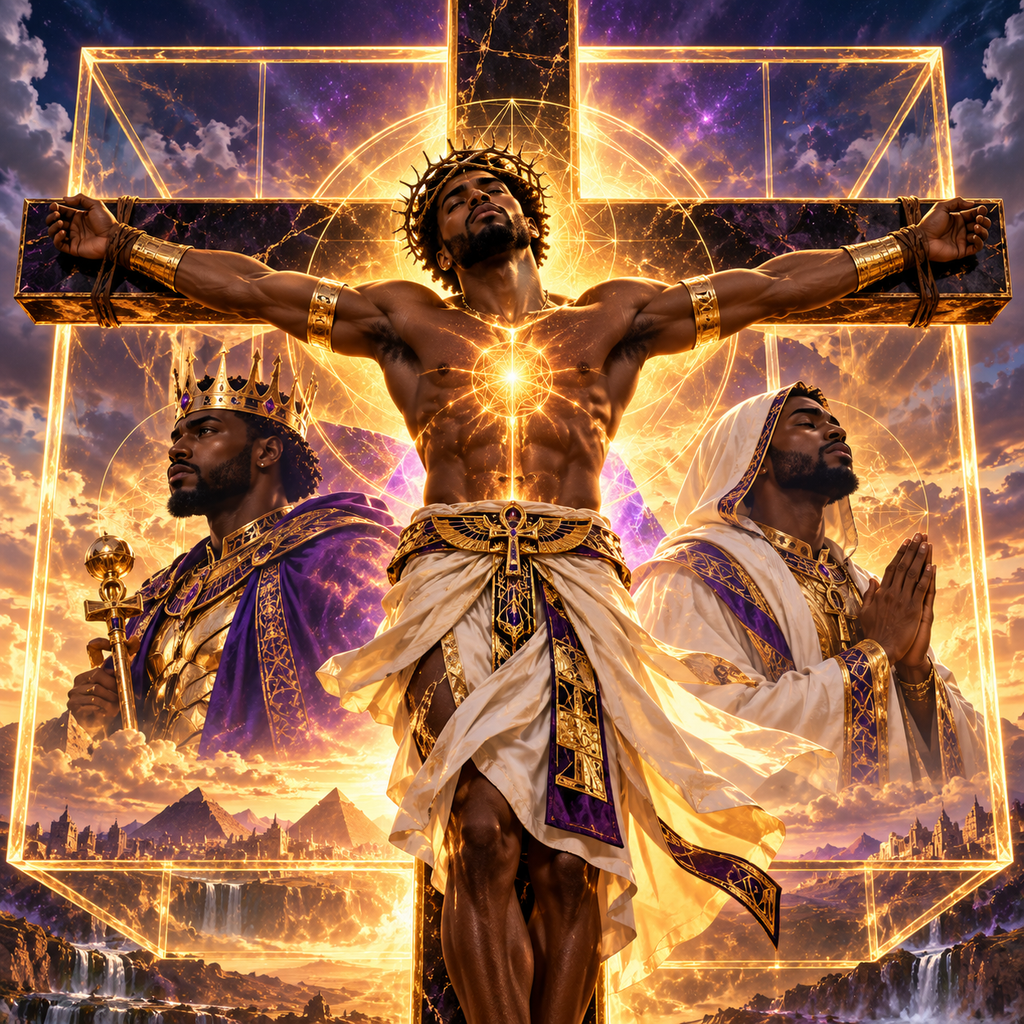
The sacred geometry assigned to the Veil Chakra is the Cross, understood as an unfolded Cube.
A Cube has six square faces arranged into a three-dimensional structure. When unfolded along the appropriate edges, those six faces can lie flat to form a two-dimensional cross.
Nothing has been added to the Cube. Its faces have not changed. What changes is the arrangement through which their relationships become visible.
This is a powerful picture of Adam’s awakening.
The Cube is his classroom. The Cross represents the unfolding of understanding concerning that classroom and his place within it.
Adam does not acquire a new essential identity when the Cube unfolds. He recognizes an identity that was already his.
The Two Axes of the Cross
- The vertical axis symbolizes Adam’s relationship with Source. It represents divine orientation, spiritual purpose, and the distinction between Creator and creation.
- The horizontal axis symbolizes Adam’s experience within incarnation: circumstances, relationships, limitations, time, persona development, and consequence.
- Their intersection represents Adam’s recognition of his position within these two realities.
He is creation, experiencing incarnation while remaining responsible for his Inner Kingdom and accountable to Source.
The Order of the Unfolding
The order of this development matters:
- Understanding
- Conviction
- The lifting of the Veil
- The Cube unfolds into the Cross
The Cross does not cause Adam’s awakening. It symbolizes what is revealed when understanding becomes conviction.
Nor does the unfolding mean the Cube has been destroyed.
Adam remains within the classroom. The architecture continues to serve its purpose. What has changed is his comprehension of the structure and his place within it.
He can now examine the classroom without mistaking it for the whole of his existence.
6. Deny Yourself: The Rejection of Mistaken Identity
In Matthew 16:24, Jesus gives the instruction:
“If any man will come after me, let him deny himself, and take up his cross, and follow me.” — Matthew 16:24, KJV
Related teachings appear in Mark 8:34 and Luke 9:23.
Within the 18-ChakraVerse interpretation, this instruction concerns Adam’s mistaken understanding of himself.
To deny oneself does not mean Adam must reject his actual existence. It does not require him to despise the physical body, abandon responsibility, or destroy the personas he has developed.
He must deny his mistaken idea of himself.
For much of his education, Adam has believed himself to be the identities through which he experiences life. He has defined himself through the body, through circumstances, through accomplishments, and through the characteristics of his personas.
Now he must recognize that none of these are his essential identity.
- He has a body, but he is not the body.
- He has personas, but he is not the personas.
- He exercises authority within his Inner Kingdom, but he is not the ultimate Creator.
He is a god-spark created by Source.
This is what Adam must recognize as real.
The instruction to deny himself therefore becomes an invitation to relinquish mistaken identification, not to reject the true self.
The distinction matters, because Adam’s personas are not inherently undesirable. They have been developed through experience and may possess valuable capacities. Some are aligned. Others serve protective functions as shadows-in-service. Still others may require correction, repurposing, or dissolution.
Their value and function must be evaluated, but their existence does not make them Adam.
The central transformation is recognition.
Adam must cease confusing the construction with the constructor.
7. Take Up Your Cross: The Pain of Realization
The Cross is commonly associated with suffering. Within this interpretation, that suffering has a specific spiritual meaning.
It is the pain of recognizing that Adam is not who he believed himself to be.
For much of his existence, Adam has lived through familiar identities. He has developed attachments to their characteristics, their accomplishments, their relationships, and their histories.
Those identities have given him continuity. They have given him ways to understand himself and navigate the world.
Then the Veil lifts.
Adam recognizes that the characters he has experienced as himself are constructions.
This realization may be profoundly unsettling.
He has not been betrayed by his personas. They have not conspired against him or deliberately concealed his identity. They have simply performed the functions for which they were developed.
Yet Adam may experience the realization as though something familiar has betrayed him, because his previous understanding of himself can no longer be sustained.
The image of being nailed to the Cross expresses the intensity of this recognition. He cannot return to his former identification without denying what he now understands.
The pain arises from understanding itself.
No external attack is necessary. No particular physical event must occur. The transformation takes place as Adam recognizes the difference between what he is and what he has constructed.
What must be sacrificed is not the body or the personas.
It is mistaken identity.
The body remains Adam’s vessel for incarnation. His personas remain available for continued development and service. His responsibilities remain.
But his relationship with these constructions changes.
He no longer needs to believe he is the King in order to exercise kingly capacities. He no longer needs to believe he is the Priest in order to benefit from priestly development.
He can recognize both as constructions operating within his Inner Kingdom.
This is the sacrifice represented by the Cross.
8. The Crucifixion: Adam Dies as King and Priest
The symbolic death represented by the crucifixion is the ending of Adam’s mistaken identification with his constructions.
It is not the death of the god-spark.
Adam has spent much of his education identifying himself with the King developed through the Solar Plexus and the Priest developed through the Heart. These personas have served important developmental purposes. Through them, Adam has explored authority, responsibility, spiritual alignment, reconciliation, and governance.
But they are not Adam.
At the Veil, he recognizes this distinction.
- He figuratively dies as King, because he no longer believes himself to be the kingly persona.
- He figuratively dies as Priest, because he no longer believes himself to be the priestly persona.
The death is the ending of identification.
This does not require the destruction of either persona. The King may continue exercising governance functions. The Priest may continue serving the spiritual needs of the Inner Kingdom. Their development remains available to Adam.
In fact, their capacities may become more useful once Adam understands how to govern them without confusing their interests with his own identity.
The crucifixion therefore represents a fundamental change in consciousness.
Adam relinquishes the belief that he is the characters he has constructed. He does not relinquish his responsibility for them.
This distinction prepares the way for resurrection.
9. The Resurrection: Adam Recognizes Himself as a Son of God
Within the 18-ChakraVerse interpretation, the resurrection represents Adam’s conscious recognition of his true identity.
He is a god-spark brought into existence by Source.
He is a son of God.
But Adam does not become a son of God at the moment of resurrection. He was already creation.
His relationship with Source existed before he understood it. His essential identity was not produced by the crucifixion, nor was it created by the lifting of the Veil.
The resurrection reveals that identity to his consciousness.
This is the difference between becoming something new and recognizing what has always been true.
| Symbolic Death | Symbolic Resurrection | |
|---|---|---|
| The movement | What Adam relinquishes | What Adam recognizes |
| The content | Identification with the King and Priest; the belief that his body and personas define his essential self | His identity as a god-spark created by Source, and his responsibility for the constructions of his Inner Kingdom |
Adam has not become a different creation. He now understands what he has always been.
This recognition changes how he approaches existence. Instead of experiencing every persona’s struggle as the totality of his identity, Adam can examine those struggles from the perspective of the one responsible for the kingdom.
- He can recognize patterns without immediately acting on them.
- He can observe conflict without becoming the conflicting persona.
- He can evaluate the purpose of a construction without believing that its continued existence defines his own.
He is beginning to understand the distinction between being a participant in the drama of his personas and being responsible for their governance.
Yet resurrection does not make Adam omniscient, perfect, or exempt from consequence.
He still has much to learn.
10. Follow Me: Adam Begins Exercising Conscious Kingship
The final portion of the instruction to take up the Cross is especially significant:
“Follow me.”
Within this allegorical reading, Adam is speaking to his persona.
He is not merely telling the persona to imitate another character’s behavior. He is establishing the relationship between the one responsible for the Inner Kingdom and the construction operating within it.
Adam is becoming conscious of his authority.
Previously, he experienced life through his personas without fully distinguishing himself from them. Their desires, fears, ambitions, and judgments could dominate his perspective, because he believed their identities were his own.
Now he can begin to direct them consciously.
The King remains a persona. The Priest remains a persona. Other constructions continue serving their particular functions.
But Adam recognizes that he is responsible for governing them.
This is the emergence of conscious kingship.
Adam has always possessed jurisdiction over his Inner Kingdom. The Veil does not grant him sovereignty for the first time. It brings him into conscious recognition of the authority already entrusted to him.
The Order of Authority Remains Unchanged
- Source is Creator: the origin of the blueprint and the authority responsible for divine evaluation and initiation.
- Adam is creation: a god-spark responsible for constructing and governing his Inner Kingdom.
- Personas are Adam’s constructions: developed to perform functions and participate in experiences.
This distinction does not mean Adam’s personas automatically become cooperative. They may retain competing interests, established patterns, or misaligned tendencies.
Recognition is not the same as mastery.
Adam must still learn how to govern wisely. He must examine his constructions, recognize their functions, evaluate their alignment, and determine when a persona should be developed, redirected, repurposed, or retired.
The difference is that he can now take up this responsibility without mistaking himself for the construction being examined.
He is moving from unconscious identification toward conscious construction.
11. The Veil Has Lifted, but the Classroom Remains
One of the most important distinctions in the Veil Chakra is this: awakening does not mean graduation.
Adam has recognized his true identity, but his education within the Cube is not complete.
He remains embodied. He continues to encounter circumstances. He still experiences the consequences of his choices and constructions.
The world does not suddenly become subject to his personal authority because he recognizes himself as a god-spark.
The classroom remains under Source’s jurisdiction. Adam’s authority remains his Inner Kingdom.
What changes is his understanding of the classroom.
Previously, he may have mistaken earthly circumstances and persona experiences for the entirety of his existence. Now he recognizes that these experiences belong to a larger developmental process.
He can begin observing his circumstances rather than automatically identifying with every response that arises within him. He can examine the relationship between intention, construction, action, and consequence.
This is a significant development, because Adam is learning to become the observer of his own constructions.
A circumstance may provoke anger, fear, desire, or resistance. A persona may be ready to act according to an established pattern. Adam can now recognize that activity without immediately becoming identified with it. He can examine what is occurring within his kingdom and decide how to govern it.
This does not mean emotion disappears, or that circumstances cease to be difficult. Nor does it mean Adam can control the variables operating beyond his jurisdiction.
It means he is becoming more capable of recognizing his own participation in the consequences he experiences.
Eve’s Seven Capacities continue assisting him in recognizing and constructing what is good. Adam’s Nine Attributes remain essential to his development, because conscious recognition alone does not guarantee consistent good construction.
He must still develop:
Love, Joy, Peace, Patience, Kindness, Goodness, Faithfulness, Gentleness, and Self-control.
Understanding who he is does not automatically make him capable of exercising every attribute maturely.
The education continues.
The Cube remains his classroom until that education reaches its appointed completion.
12. The King and Priest Are Being Readied for Initiation
The Veil Chakra also changes Adam’s relationship with the King and Priest he has developed.
Before the Veil lifts, Adam may identify with these personas and evaluate their experiences as though they were his own.
After the Veil lifts, he recognizes that they are constructions.
This recognition allows him to examine their development more consciously.
The King has been developed through the Solar Plexus. The Priest has been developed through the Heart. Both have acquired capacities through Adam’s experiences within the Cube.
Now Adam can evaluate them without confusing their functions with his identity. He can recognize where development remains necessary. He can examine their cooperation and determine whether their characteristics serve the purpose for which they were constructed.
Their continued preparation becomes part of his conscious responsibility.
But Adam does not possess the authority to initiate himself or his personas simply by declaring that their development is complete.
Initiation belongs to Source.
The Creator retains authority over the blueprint, divine evaluation, and the appointed completion of Adam’s education.
Adam’s responsibility is to continue learning, developing, and governing within the jurisdiction entrusted to him.
The King and Priest are being readied for initiation, but preparation is not completion.
The Veil represents the awakening that makes conscious preparation possible. It does not represent the final judgment of Adam’s development.
13. The Biblical Pattern: From Concealment to Recognition
The Veil Chakra draws together several biblical teachings through the 18-ChakraVerse’s allegorical method.
- Genesis 49:16 establishes Dan’s association with judgment, the foundation for this chakra’s discerning function.
- Isaiah 11:2 names Understanding among the spiritual capacities that, within this framework, belong to Eve’s Seven Capacities.
- Matthew 16:24, Mark 8:34, and Luke 9:23 give the instruction to deny oneself, take up the Cross, and follow.
- Matthew 10:38 and Luke 14:27 reinforce the personal responsibility associated with bearing the Cross.
- 2 Corinthians 3:14–16 is where Paul discusses the Veil in connection with obscured understanding and its removal. In verse 18, the image of an unveiled face accompanies transformation.
These passages establish an important relationship between concealment, understanding, and change.
The crucifixion and resurrection narratives supply the symbolic pattern through which the 18-ChakraVerse examines the death of mistaken identification and the recognition of Adam’s true identity.
The Wedding at Cana, in John 2:1–11, provides a related developmental demonstration: the Jesus persona has already achieved the king-priest integration necessary to sustain Christ consciousness.
Taken together, these accounts form a coherent allegorical progression within the 18-ChakraVerse.
A note on interpretation: The Cross as an unfolded Cube, Adam’s figurative death as King and Priest, and resurrection as the recognition of his god-spark identity are the specific metaphysical interpretations developed in this system. They are not presented as the conventional historical or doctrinal readings of those passages. Their purpose here is to illuminate the process through which Adam moves from unconscious identification to conscious construction.
14. The Complete Transformation of the Veil Chakra
The Veil Chakra can be understood as a developmental progression that begins with experience and culminates in conscious responsibility:
- Experience. Adam learns within the Cube through the personas he constructs.
- Understanding. Through Eve’s capacity, Adam begins recognizing the architecture of his existence.
- Conviction. Adam becomes convinced of his identity as creation.
- The Veil lifts. He distinguishes Creator, creation, and construction.
- The Cross. The Cube symbolically unfolds, revealing relationships previously concealed.
- Symbolic death. Adam relinquishes identification with the King, the Priest, the body, and other personas.
- Resurrection. Adam consciously recognizes himself as a son of God.
- Conscious governance. Adam begins directing his constructions rather than identifying with them.
- Continued education. He remains within the Cube, learning through circumstance and consequence.
- Preparation for initiation. The King and Priest continue developing under Adam’s governance, while Source retains the authority to evaluate and initiate.
This sequence describes a conceptual progression, not a rigid series of separate events. Understanding, conviction, symbolic death, and resurrection may overlap as Adam develops.
The central movement is from mistaken identification to recognition, and from recognition to conscious responsibility.
Conclusion: The Resurrection of the Conscious Adam
Adam entered the Cube to experience life, develop personas, and learn through consequence.
He constructed characters to navigate circumstances and accomplish particular purposes. Through the Solar Plexus, he developed kingly capacities. Through the Heart, he developed priestly capacities.
He experienced life through these constructions so completely that he came to believe their identities were his own. He believed himself to be the body, the ruler, the priest, the sufferer, and the many other characters through which he participated in existence.
Then Understanding began to unfold.
The Veil lifted.
Adam recognized Source as Creator, himself as creation, and his personas as constructions.
The realization was painful, because he could no longer identify with the familiar characters through which he had experienced life.
Nothing external had to happen. His personas had not betrayed him. His body had not betrayed him.
The pain arose from understanding.
The Cube unfolded into the Cross, symbolizing the revelation of Adam’s place within creation.
He figuratively died as the King and Priest he had mistaken himself for.
And he was resurrected into the conscious recognition that he is a son of God: a god-spark created by Source.
Yet the resurrection did not end his education.
Adam remains within the Cube. He still has a body. He still develops personas. He still encounters circumstances and learns through consequence. He still has to develop the attributes that make consistent good construction possible.
But now he understands something fundamental.
- He knows that he is not the characters he has constructed.
- He knows that Earth is his classroom, not his kingdom.
- He knows that his Inner Kingdom is his responsibility.
- He knows that Source remains Creator.
And he is becoming capable of consciously governing what he constructs.
The King and Priest are being readied for initiation. Adam continues his education, while Source retains authority over its completion.
The Veil Chakra, then, does not represent the end of Adam’s journey.
It represents the awakening that changes how he continues that journey.
Adam has not become something he was not before. He has awakened to what he has always been.
Reflect: Your Own Veil
If this teaching resonates, sit with these questions:
- Which persona do you most often mistake for yourself: the one who rules, the one who serves, the one who protects, or the one who suffers?
- When a circumstance provokes a strong reaction, can you pause long enough to notice which construction is responding?
- What would change if you related to your King and your Priest as constructions you govern, rather than identities you are?
The 18-ChakraVerse explores the movement from unconscious construction to conscious construction through sacred geometry, biblical allegory, Eve’s Seven Capacities, and Adam’s Nine Attributes.