
Benjamin • The Octahedron • Restitution & Grace
By Iris J Chapman
There is something Adam must learn that no book, service, meditation practice, or declaration of spiritual awakening can hand him.
He must learn grace.
Grace for what he does not understand. Grace for the mistakes he makes while learning. Grace for the limits of his physical existence. Grace for the personas he has built that no longer serve him. And, perhaps hardest of all, grace for the countless other Adams who are also trying to navigate existence with incomplete understanding.
This is no small assignment.
Adam lives in an external world filled with other Adams. Each carries different experiences, perspectives, limitations, and constructions. Their interests do not always align. Their understanding is not always equal. Their decisions can create consequences that reach far beyond their own Inner Kingdoms.
Yet Adam must learn to cooperate.
He cannot wait until everyone else becomes considerate, reasonable, or spiritually mature before he begins his own development. Nor can he wait for some extraordinary crisis to discover whether he knows how to practice grace.
Grace is learned in the ordinary circumstances of living.
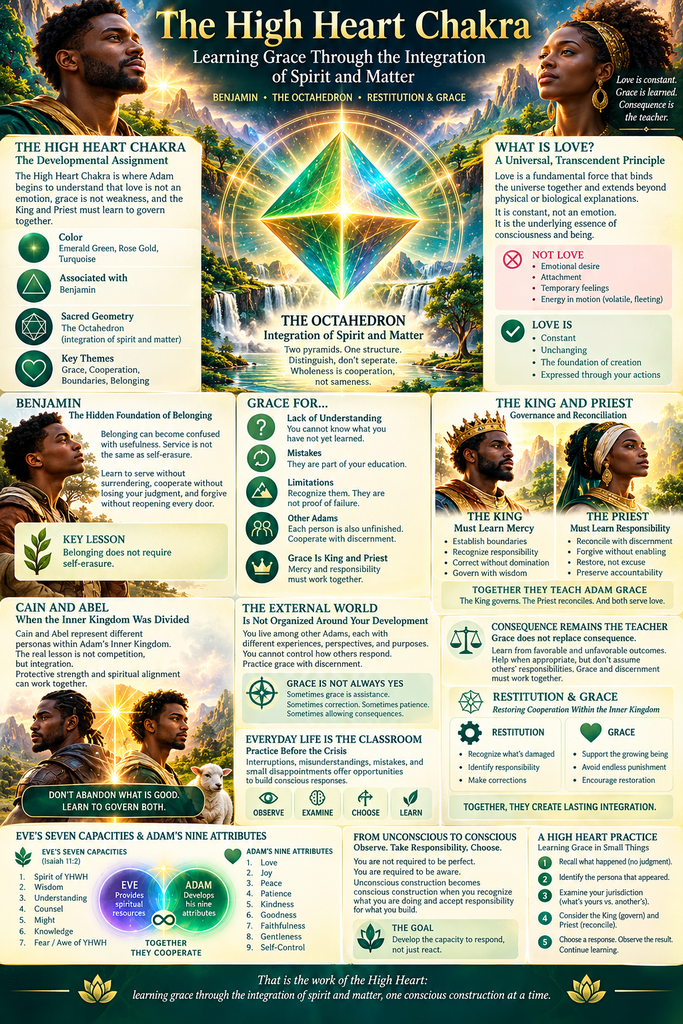
This is the developmental assignment of the High Heart Chakra, the non-inherited realm associated with Benjamin and the sacred geometry of the Octahedron. Within The 18-ChakraVerse, the High Heart is where Adam begins to understand three things: love is not an emotion, grace is not weakness, and the King and the Priest must learn to govern together.
Benjamin: The Hidden Foundation of Belonging
Benjamin represents the hidden foundation of belonging.
Every Adam enters a world where cooperation is necessary. He depends on others for much of his early development, and he goes on participating in families, relationships, workplaces, communities, and societies for the whole of his physical existence.
But belonging can be confused with usefulness.
Adam may construct a persona that believes acceptance must be earned through constant service. He becomes the one who always helps, always forgives, always accommodates, and always carries the responsibilities others leave behind.
From the outside, this persona looks extraordinarily generous. Inside, Adam may be operating under an entirely different construction: If I stop being useful, I will lose my place.
This is one of Benjamin’s developmental challenges. Service becomes payment for belonging. Compassion becomes obligation. Loyalty becomes captivity. Forgiveness becomes repeated permission for destructive behavior.
Eventually resentment arrives, because Adam has surrendered responsibilities within his own Inner Kingdom while trying to hold a place in someone else’s world.
The High Heart does not teach Adam to stop serving. It teaches him to understand service.
Adam can offer help without taking on another person’s responsibilities. He can cooperate without surrendering his judgment. He can forgive without reopening every door. He can recognize another Adam’s limitations without making those limitations his permanent assignment.
Benjamin must learn that belonging does not require self-erasure.
That lesson opens a larger question: what principle makes cooperation possible in the first place? To answer it, we have to examine love.

What Is Love?
Love is one of the most discussed subjects in human experience, yet it is constantly confused with emotional desire.
People call attraction love. They call attachment love. They call the satisfaction of being wanted, needed, admired, or desired love.
But these experiences vary. Attraction fades. Attachment shifts. Desire is fulfilled or frustrated. Emotional satisfaction disappears when circumstances change.
If love depended on these experiences, love would rise and fall with them. That is not the metaphysical understanding of love we are examining in The 18-ChakraVerse.
Love is a fundamental, transcendent, and unifying principle of the Creator’s architecture. Adam does not manufacture it through his emotions. His relationships do not create it, and it does not cease to exist when those relationships change.
Love is constant.
Emotion, often described in metaphysical traditions as energy in motion, belongs to Adam’s changing experience. It can be intense, fleeting, volatile, or unpredictable. Love cannot be defined by any of those qualities.
Adam may feel affection while expressing love, but affection is not love itself. He may feel anger and still act in accordance with love. He may long for another person’s presence without yet having the understanding needed to love that person constructively.
The distinction matters because Adam must learn to govern what he experiences without mistaking those experiences for the underlying principles of creation.
Love does not become more real because Adam feels strongly. Nor does it disappear because he is disappointed.
Adam Does Not Create Love
Within The 18-ChakraVerse, Adam is creation, not Creator. The Creator establishes the architecture. Adam must learn to function within it.
Love belongs to that architecture. Adam cannot manufacture it, redefine it to suit his preferences, or determine its nature through his feelings.
What Adam can develop is his capacity to recognize love and express it through his constructions.
This matters when we look at the nine attributes named in Galatians 5:22–23: love, joy, peace, patience, kindness, goodness, faithfulness, gentleness, and self-control.
Love comes first, but Adam is not developing love as though the principle did not already exist. He is developing his capacity to express it.
And that requires learning.
Adam must learn everything. Anything he takes for granted can become a detriment to his development. The existence of love does not guarantee that he understands it, and having the capacity to express it does not mean he has learned to exercise that capacity consistently.
This is where the High Heart becomes essential.
The Octahedron: The Integration of Spirit and Matter
The sacred geometry of the High Heart Chakra is the Octahedron: eight triangular faces, six vertices, and twelve edges. Picture two square pyramids joined at a shared base.
Within The 18-ChakraVerse, this geometry represents the integration of spirit and matter.
The two pyramids are distinguishable, yet they form one structure. Neither pyramid alone is the Octahedron. This gives us a geometric model for integration: spirit and matter do not have to become identical. They keep their distinct functions and still participate in one existence.
Metaphysical integration is the process of bringing apparently fragmented aspects of consciousness, experience, and being into a unified whole. Wholeness is not achieved by eliminating differences. It is recognized and expressed through cooperation.
Adam must learn this.
He may develop spiritual understanding while neglecting his physical responsibilities. He may become so occupied with material circumstances that he ignores the spiritual dimension of his development. He may construct personas that compete for authority instead of cooperating within his Inner Kingdom.
The problem is not that these capacities exist. The problem is that Adam has not yet learned to govern them together.
It is not enough for Adam to declare that spirit and matter are one. He must learn what that means when he makes decisions, meets his limitations, accepts consequences, and interacts with other Adams. The integration must become operational.
One of its most important expressions is grace.
Grace: Learning to Express Love
If love is constant, grace is something Adam must learn to practice.
Within The 18-ChakraVerse, grace is a developed capacity through which Adam consciously expresses love while recognizing imperfection, limitation, responsibility, and consequence.
Grace is not simply an emotional reaction to suffering. It is not an excuse for destructive behavior. It is not the abandonment of judgment, boundaries, or responsibility.
Grace is necessary because Adam is learning. He does not enter the Cube with a complete understanding of himself, his purpose, his personas, or the circumstances he will meet. He learns through experience.
Sometimes his decisions produce favorable consequences. Sometimes he builds something that does not serve him. Sometimes what seemed reasonable under one set of circumstances proves unsuitable under another. He may misunderstand another Adam, overestimate his own abilities, or act from a persona that has not yet matured.
Grace lets him acknowledge these realities without abandoning the work of development. It is needed in four places.
Grace for Lack of Understanding
Adam cannot know what he has not yet learned.
That does not remove his responsibility to seek understanding. But it does draw a line between incomplete knowledge and deliberate wrongdoing. A mistake made in ignorance is not the same construction as an action taken with the intention to exploit or harm.
Adam must learn to recognize the difference, and to extend that same consideration to others. No Adam holds complete knowledge of another person’s experiences, circumstances, history, or inner constructions.
Grace makes room for what Adam does not know.
Grace for Mistakes
Mistakes are part of Adam’s education.
Their consequences may be uncomfortable, costly, embarrassing, or painful. Some can be corrected quickly. Others cannot be fully reversed.
Grace does not erase those consequences. It allows Adam to recognize what happened, accept responsibility, make appropriate corrections, and keep learning.
Self-condemnation is not the same as accountability. Adam can acknowledge an unsuccessful construction without declaring himself incapable of producing what is good.
Grace for Limitations
Adam lives in a physical body. He meets fatigue, changing circumstances, limited resources, competing responsibilities, and countless conditions beyond his control.
He must learn what belongs to his jurisdiction and what does not.
Grace allows him to acknowledge his limits without treating them as permanent proof of failure. He may need rest. He may need help. He may need more time to develop a capacity. He may find that a responsibility exceeds what he can reasonably carry right now.
Recognizing those limits can itself be an act of conscious governance.
Grace for Other Adams
This may be the most demanding part of the High Heart’s assignment.
Adam must learn to cooperate with other Adams who are also unfinished. They will misunderstand him. They will make mistakes. They may disappoint him, disagree with him, or behave in ways he finds unreasonable.
Sometimes his assessment will be correct. Sometimes it will not.
Grace asks him to remember that his perspective is not the whole of another Adam’s existence. Yet grace does not require him to accept every behavior. He may set boundaries, decline to participate, correct misinformation, or allow another person to experience the consequences of their choices.
Grace must cooperate with governance. And that brings us to the King and the Priest.
Grace Is King and Priest
The Octahedron represents integration. Within the High Heart, one of the most important integrations is that of King and Priest.
The King represents governance. The Priest represents reconciliation. Adam’s Inner Kingdom needs both.
The King Must Learn Mercy
The King establishes order, makes decisions, recognizes responsibility, and maintains boundaries. He must learn to distinguish what belongs to Adam from what belongs to another.
He must also learn that authority does not require unnecessary punishment or domination. A King who sees only wrongdoing, without considering development, becomes rigid and punitive. He tries to keep order through control instead of understanding.
Grace teaches the King that correction and condemnation are not the same thing.
The Priest Must Learn Responsibility
The Priest represents reconciliation, forgiveness, compassion, and restoration.
But reconciliation without discernment becomes accommodation of destructive behavior. Forgiveness does not automatically restore trust. Compassion does not require Adam to carry another person’s responsibilities. Understanding someone’s limitations does not erase the consequences of their decisions.
The Priest must learn that grace is not the abandonment of accountability.
Their Cooperation Makes Grace Operational
| The King | The Priest |
|---|---|
| Recognizes what requires correction | Recognizes the developing being |
| Maintains boundaries | Preserves the possibility of reconciliation |
| Must learn mercy | Must learn responsibility |
Together they allow Adam to respond constructively without demanding perfection from himself or anyone else.
The King must learn mercy. The Priest must learn responsibility. Together, they teach Adam grace.
This is not the creation of love. It is Adam developing the capacity to express love through integrated functions.
Cain and Abel: When the Inner Kingdom Was Divided
The account of Cain and Abel offers an early example of Adam’s difficulty with integration.
Within The 18-ChakraVerse, biblical characters are read as personas within one Adam’s developing Inner Kingdom.
Cain is a shadow-in-service persona. His characteristics suit protection and the navigation of hard external circumstances. Abel is an aligned persona, constructed in a way favorable to the Creator’s purpose.
Both carry functions Adam could learn to govern.
But when Abel receives divine favor and Cain does not, Adam faces a problem. He sees the practical advantages of the Cain construction in the external world. Rather than learning to develop and govern both capacities together, he abandons Abel.
The result is division.
This is not merely a story of two rival brothers. Within our framework, it shows Adam struggling to govern different aspects of his own construction. He must eventually learn that protective strength and spiritual alignment do not have to be enemies.
The biblical narrative continues through rulers, prophets, priests, and messengers, each offering further examples of development through consequence.
In our examination of the Wedding at Cana, we established that Jesus is the first persona Adam has developed with the capacity to sustain Christ consciousness. Jesus demonstrates the integration of kingly and priestly functions, and the water turned to wine reveals a development already achieved rather than creating it at the wedding. Paul then carries forward the continuing development of the aligned Priest.
The High Heart shows us why this integration matters. A kingdom cannot be governed well by authority alone. Nor can it be sustained by reconciliation that abandons responsibility.
Adam must learn grace.
The External World Is Not Organized Around Adam’s Development
One reason grace is so hard to learn is that Adam lives among other Adams, each constructing an Inner Kingdom under different circumstances. Their purposes, responsibilities, perspectives, and progress may differ greatly from his.
Adam cannot assume that others will understand his intentions, respect his boundaries, or respond as he expects. The external world presents variables.
Kindness may be met with gratitude, indifference, suspicion, or exploitation. A reasonable boundary may be honored by one person and tested by another. An offer of help may support someone’s development in one situation and interfere with necessary consequences in another.
Adam cannot control these outcomes. His jurisdiction remains his Inner Kingdom.
He can choose how he responds, which personas he develops, and which responsibilities he accepts. He cannot govern the inner development of everyone he meets.
This is why grace must be practiced alongside discernment. Grace is not a universal instruction to say yes. Sometimes it looks like assistance. Sometimes correction. Sometimes patience. Sometimes it means allowing another Adam to experience the consequences of a decision.
The right expression depends on the circumstances. There is no formula that removes Adam’s need to think.
Everyday Life Is the Classroom of Grace
Adam cannot wait for a major challenge to begin learning grace.
Consider someone who has never practiced patience, discernment, or self-control in ordinary situations. When a serious crisis comes, that person is suddenly asked to use capacities that were never built. A crisis is rarely the ideal time to begin construction.
Everyday life offers constant practice. Someone interrupts Adam while he is concentrating. Someone’s mistake costs him time. A family member misreads his intentions. A coworker fails to finish a task. A stranger behaves inconsiderately.
These moments may seem small beside major losses, betrayals, or crises. But each is a chance to practice a conscious response.
Adam may notice irritation without acting on it immediately. He may correct someone without humiliating them. He may acknowledge another person’s limitations while keeping reasonable expectations. He may recognize his own error and correct it without building a persona devoted to self-condemnation.
Every experience offers information.
Observation Before Action
Within The 18-ChakraVerse, Adam develops personas that he puts on to perform particular functions. Some are aligned. Some operate as shadows in service. Others may become misaligned.
Adam must learn to observe his inner responses before automatically reaching for a familiar persona.
When someone challenges him, he may notice the urge to defend himself. When someone disappoints him, he may feel the pull to withdraw, retaliate, or condemn. These responses reveal his existing constructions.
But recognizing a response does not require acting on it. Adam can observe, examine the circumstances, and choose a response that fits his responsibilities.
This is not the elimination of emotion. Emotion remains part of his physical experience. The aim is to keep temporary experiences from automatically governing his decisions.
Practice Develops Reliable Capacity
The more Adam practices conscious responses, the more opportunities he has to develop and refine his personas. He learns which responses serve his purpose and which create unnecessary difficulty. He discovers where boundaries are needed, where his understanding is incomplete, and where old constructions need adjustment.
The goal is not to guarantee that Adam will respond perfectly to every future challenge. Circumstances remain variable.
But repeated practice gives him developed capacities to draw on when harder circumstances arrive.
Grace practiced in ordinary circumstances becomes available in extraordinary ones.
Consequence Remains the Teacher
Grace does not replace consequence. This distinction is essential.
Adam develops through experience, and experience produces outcomes. Some are favorable. Others reveal limitations, errors, or misalignment. Adam must learn from both.
The presence of grace does not mean every consequence will be pleasant. Nor does it mean Adam should shield others from the results of their decisions.
Sometimes intervention is right. Sometimes it is not. The High Heart asks Adam to examine the difference.
When another Adam makes a mistake, help may restore what was damaged. But repeatedly taking on another person’s responsibilities may keep that person from developing the capacities they need.
Grace must therefore be exercised with discernment. Adam can stay committed to love without claiming authority over someone else’s learning.
The King recognizes jurisdiction. The Priest recognizes the possibility of restoration. Together they let consequence remain instructive without making condemnation the governing principle.
Restitution and Grace: Restoring Cooperation Within the Inner Kingdom
The High Heart’s Department of Restitution & Grace offers another way to see this work.
Restitution recognizes what has been damaged, identifies responsibility, and makes appropriate corrections. Grace attends to the continued development of the being who must learn from the experience.
These functions cooperate. Restitution without grace becomes endless punishment. Grace without restitution becomes an excuse to avoid necessary correction. Neither produces mature integration on its own.
When Resentment Appears
Resentment is especially important in Benjamin’s development.
Adam may have spent years giving more than he reasonably could, accepting responsibilities that were never his, or holding relationships together through constant accommodation. Eventually, resentment surfaces.
In the High Heart framework, resentment can be a signal that Adam needs to examine his constructions:
- Has he repeatedly agreed to responsibilities he did not want?
- Has he confused service with belonging?
- Has he neglected his own boundaries?
- Has he expected repayment for sacrifices that were never openly agreed upon?
The answers will vary. Resentment does not automatically prove that someone else behaved wrongly, or that Adam’s boundaries were violated. It is an invitation to investigate.
Adam must recognize the circumstances, evaluate his own participation, and determine what needs correction.
Restitution may mean changing a commitment, setting a boundary, correcting a misunderstanding, or redirecting energy toward neglected responsibilities. Grace allows him to make that correction without turning the experience into permanent bitterness.
The purpose is the restoration of conscious cooperation.
Eve’s Seven Capacities and Adam’s Nine Attributes
Adam does not undertake his development alone.
Within The 18-ChakraVerse, Eve is the Spirit-given Helpmeet and Manifestor-in-Chief, entrusted with the seven capacities named in Isaiah 11:2: the Spirit of YHWH, Wisdom, Understanding, Counsel, Might, Knowledge, and the Fear (or Awe) of YHWH.
These capacities help Adam recognize and construct what is good. He must learn to cooperate with Eve rather than assume that having spiritual resources means he already knows how to use them.
His own nine attributes must also be developed: love, joy, peace, patience, kindness, goodness, faithfulness, gentleness, and self-control. They are not isolated achievements. They cooperate.
Grace is not listed among the nine, but practicing it draws on several of them:
- Patience when another Adam makes a mistake
- Kindness in the manner of correction
- Goodness in attending to what is aligned
- Gentleness in shaping how authority is expressed
- Self-control in keeping a passing impulse from becoming a destructive action
These attributes are not interchangeable, yet they can cooperate within a single response.
This is another expression of the Octahedron’s central principle. Wholeness does not require every function to become identical. It requires conscious integration.
From Unconscious Construction to Conscious Grace
Adam may begin by reacting automatically to whatever surrounds him.
He may confuse emotional desire with love, usefulness with belonging, forgiveness with surrender, or authority with control. He may condemn himself for every mistake while expecting perfection from others. These patterns can become deeply practiced personas.
But Adam is not required to stay governed by them.
He can observe his constructions, examine their consequences, and begin developing different responses. Unconscious construction becomes conscious construction when Adam recognizes what he is doing and accepts responsibility for what he continues to build.
The High Heart brings grace into that process.
Adam learns that recognizing an error does not require abandoning himself. He learns that another person’s imperfection does not automatically justify condemnation. He learns that compassion and boundaries can work together.
Most importantly, he learns that love does not depend on the passing emotional conditions of his existence.
Love remains constant. Adam must learn to express it.
A High Heart Practice: Learning Grace in Small Things
This exercise develops observation and conscious response. It is not meant to produce any particular emotional state.
- Choose an ordinary moment. Pick a recent circumstance that challenged you. It need not be dramatic. A misunderstanding, an interruption, a disappointment, or a minor mistake is enough.
- Recall it without a verdict. Replay what happened without deciding who was right or wrong.
- Name the persona. Which persona appeared? Did you become defensive, impatient, accommodating, withdrawn, or determined to control the outcome? Observe it without condemning yourself for it.
- Examine jurisdiction. What belonged to your responsibility? What belonged to another Adam? What could you reasonably influence, and what was outside your authority?
- Consult the King. What needed governing? Was a boundary necessary? Did something require correction? Was there a responsibility to acknowledge?
- Consult the Priest. What needed reconciling? Was understanding incomplete? Was forgiveness appropriate? Could compassion be expressed without abandoning accountability?
- Choose a graceful response. Consider what grace might look like in this particular situation. There may be more than one reasonable answer. Choose an action consistent with your present understanding, observe the consequence, and keep learning.
Repeat the practice in ordinary circumstances.
The objective is not to become an Adam who never makes mistakes. It is to become an Adam who learns from them consciously.
Conclusion: Grace Is Learned in the Living
The High Heart Chakra gives Adam a demanding assignment. He must learn grace.
Not only grace for those who agree with him, appreciate him, or respond well to his efforts. Grace for himself while he is learning. Grace for his mistakes and limitations. Grace for the difficulties of physical existence. Grace for other Adams who are building their Inner Kingdoms under circumstances he may never fully understand.
Benjamin teaches him that belonging does not require self-erasure. The Octahedron shows him the integration of spirit and matter. Love provides the constant, unifying principle of the Creator’s architecture. And the King and the Priest must learn to cooperate so that grace becomes a practiced capacity rather than an abstract ideal.
Adam cannot wait for the world to become peaceful before he practices grace. He cannot require everyone else to develop understanding before he begins his own education.
The world will keep presenting variables. Other Adams will keep making decisions. Circumstances will change. Consequences will follow.
Adam’s responsibility is to learn to govern himself within those realities.
The great challenges of life may reveal what he has developed, but ordinary living provides countless chances to practice. A misunderstanding can become a lesson. A mistake can become an opportunity for correction. A boundary can become an act of responsible cooperation. An unfavorable consequence can reveal a construction that needs attention.
Through repeated practice, Adam learns to express what is constant amid what is always changing.
Love is constant. Grace is learned. Consequence is the teacher.
And the High Heart reminds Adam that he does not have to finish his development before he begins practicing what he has learned. He begins where he is, with the understanding he has, in the circumstances in front of him.
The King must govern. The Priest must reconcile. And Adam must learn to bring them together.
That is the work of the High Heart: learning grace through the integration of spirit and matter, one conscious construction at a time.