
The Watchman of the Inner Kingdom: Learning to Recognize What Harms the Whole
By Iris J Chapman
Non-Inherited Chakra · Tribe of Gad · Sacred Geometry: The Eight Vertices · Biblical Foundation: Numbers 32 · Leading Attribute: Faithfulness
Introduction: Who Is Watching the Watchman?
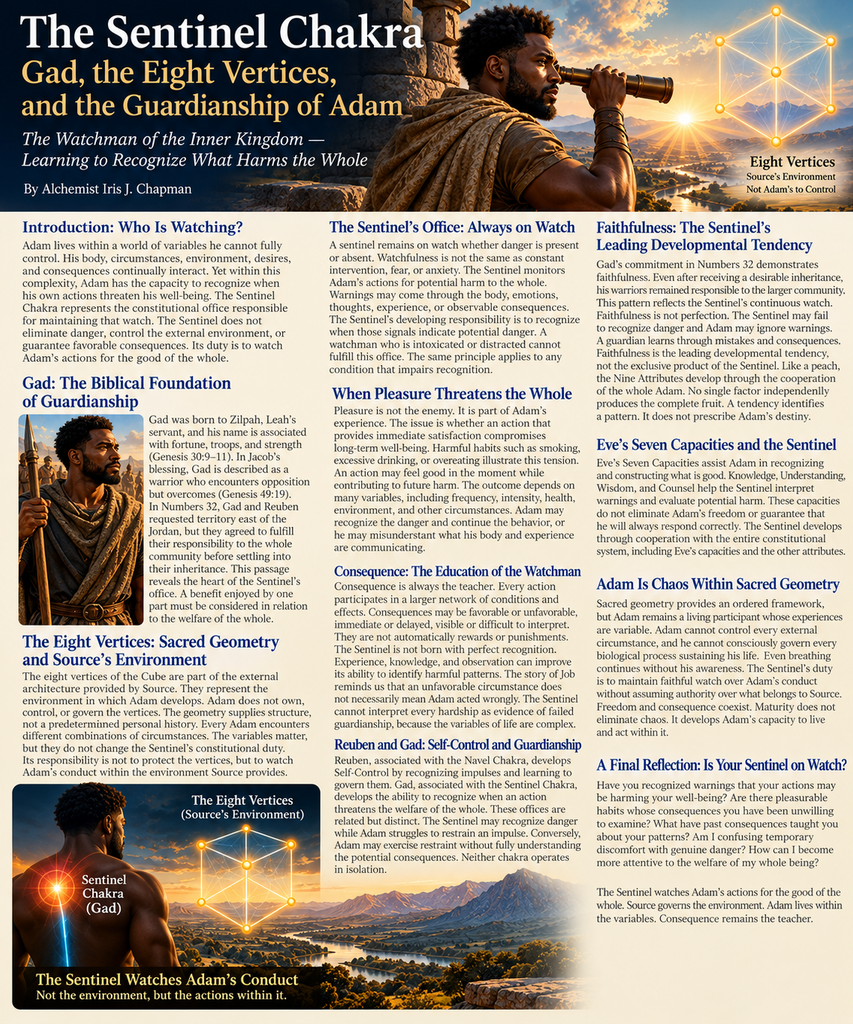
Adam lives in a world of variables. His body, his circumstances, his desires, his relationships, his environment, and the consequences of his choices interact constantly, producing experiences he cannot always predict or control. Even within his own body, countless processes run without his direction. Adam can hold his breath for a moment, but he cannot simply decide to stop breathing and remain alive.
Yet within this complex existence, Adam has a responsibility: to govern his own conduct. He must learn to recognize when his actions serve his well-being and when they threaten the welfare of his entire Inner Kingdom.
This is where the Sentinel Chakra enters the architecture of The 18-ChakraVerse.
The Sentinel is the watchman of Adam’s Inner Kingdom. Its constitutional responsibility is to stay attentive to Adam’s actions and to alert him when his conduct threatens the good of the whole. It does not control the outer environment, remove danger, or guarantee favorable outcomes. Its assignment is guardianship within Adam’s own jurisdiction.
A sentinel does not abandon the watchtower because the kingdom looks peaceful. Nor does a mature sentinel declare every unfamiliar shape on the horizon an enemy. Its work is continuous vigilance, growing recognition, and readiness to sound the alarm when it matters.
So the Sentinel’s development is not measured by how many dangers Adam avoids. It is measured by the growing competence and dependability of the watch itself.
And as the biblical account of Gad will show us, a guardian who trades responsibility for immediate personal satisfaction can place the entire kingdom at risk.
I. Gad: The Biblical Foundation of Guardianship
The Sentinel Chakra is associated with Gad, one of the twelve sons of Jacob and the ancestor of the tribe that bears his name. Gad’s biblical record carries themes of fortune, strength, conflict, inheritance, and responsibility. Together, they lay the foundation for understanding guardianship within Adam’s Inner Kingdom.
Gad and the Meaning of Fortune
Genesis 30:9–11 records Gad’s birth to Zilpah, Leah’s handmaid. His name is associated with fortune, and related Hebrew wordplay connects it with a troop or band.
Fortune introduces an important distinction. Adam meets circumstances he does not fully control. Some appear favorable, offering opportunity, security, pleasure, or abundance. Others bring hardship, uncertainty, or loss. But good fortune does not guarantee that Adam will act wisely, and hard circumstances do not prove that Adam has acted wrongly.
Adam may receive something desirable and use it destructively. He may walk through difficulty and come out with greater understanding. The circumstance itself does not determine the outcome.
Within The 18-ChakraVerse, fortune is one of the many variables Adam encounters within Source’s creation. What Adam constructs through his response becomes part of his developmental journey.
The Warrior Who Encounters Opposition
In Genesis 49:19, Jacob declares:
“Gad, a troop shall overcome him: but he shall overcome at the last.” — Genesis 49:19, KJV
The imagery presents Gad as a warrior who meets opposition and answers it. It does not describe a life without conflict.
This matters, because the Sentinel cannot be understood as a mechanism for eliminating difficulty. Adam lives among circumstances that may challenge him regardless of his preparation or maturity. A watchman must recognize danger, but recognizing danger is not the same as having the power to prevent every unfavorable outcome.
The warrior imagery speaks of resilience, preparedness, and the responsible use of strength. Yet strength alone does not make a faithful guardian. A powerful warrior who abandons his post may be more dangerous to the kingdom than a weaker one who stays attentive to his duty.
The central question is not merely what Gad can do. It is what Gad is responsible for doing.
Numbers 32: The Responsibility to the Whole
Numbers 32 provides the strongest biblical foundation for the Sentinel Chakra.
The tribes of Gad and Reuben owned a great deal of livestock. Seeing that the land east of the Jordan was well suited to their herds, they approached Moses and asked for that land as their inheritance.
Their request was understandable. They recognized an opportunity to settle their households in a favorable place.
But Moses challenged them.
The other tribes still had to cross the Jordan and secure their own inheritance. If Gad and Reuben settled comfortably while their brothers carried on the struggle, they would be enjoying their own security while abandoning their responsibility to the larger community.
The two tribes answered by agreeing to build protection for their families and livestock, then send their fighting men across the Jordan ahead of the other Israelites. Only after that commitment was fulfilled would the warriors return home to their inheritance.
The metaphysical significance is profound.
One part of a whole may enjoy pleasure, comfort, or advantage while another part remains vulnerable. The immediate benefit to one part cannot be the only measure of what is good for the entire system.
The same principle governs Adam’s Inner Kingdom.
Adam may engage in something that brings immediate satisfaction while it slowly harms his body, weakens his judgment, compromises his responsibilities, or damages his relationships. The pleasure may be real, but its consequences reach far beyond the moment of enjoyment.
The Sentinel watches for the good of the whole, not merely the satisfaction of one desire.
This is the constitutional lesson of Gad.
II. The Eight Vertices: Sacred Geometry and Source’s Environment
The Sentinel Chakra is associated with the Eight Vertices of the Cube.
A cube has six faces, twelve edges, and eight vertices. Each vertex is a point where three edges meet, holding the corners of the complete structure together.
Within The 18-ChakraVerse, the Cube represents Adam’s classroom of experience. It is the structured environment in which Adam meets circumstances, makes choices, develops personas, and lives with consequences.
The Eight Vertices belong to Source. They are part of the external architecture, not Adam’s possessions and not structures over which Adam is sovereign.
This distinction sets the boundaries of the Sentinel’s jurisdiction.
The Sentinel does not guard the vertices. It does not maintain cosmic order, govern natural law, or exercise authority over the environment Source has provided. Its responsibility is to watch Adam’s actions within that environment.
The distinction matters because Adam often mistakes participation for control. His actions can influence circumstances, but influence is not ownership, and responsibility is not omnipotence.
The geometry provides the structure. Within it, Adam meets countless variables that shape his experiences and their consequences. No two Adams meet identical circumstances, and the same Adam may respond differently to similar experiences at different stages of his growth.
The Eight Vertices therefore do not need to be given eight separate inner duties. Their place in the geometry of the Cube is enough to show us the structured environment in which the Sentinel keeps its watch.
Source provides the structure. Adam lives within the variables. The Sentinel watches Adam’s conduct for the welfare of the whole.
III. The Sentinel’s Office: Always on Watch
A sentinel is a watchman, and watchfulness is not something done only after danger becomes obvious. It is the ongoing duty of the office.
A watchman who sleeps through his shift may miss an approaching threat. A watchman who is intoxicated may lose the ability to interpret what he sees or respond well. A watchman who is distracted may overlook the very conditions that need his attention.
The danger is not simply that the watchman indulged a desire. It is that the whole kingdom becomes vulnerable when its guardian cannot fulfill its responsibility.
Within Adam, this reveals the relationship between personal conduct and collective well-being.
Adam’s body speaks in many ways. Pain, fatigue, changes in appetite, emotional distress, physical discomfort, altered functioning, and recurring behavioral patterns may all signal that something needs attention. These signals have many possible causes, and none of them automatically means Adam has done something wrong.
The Sentinel’s growing competence lies in recognizing when such signals may point to danger and bringing them to Adam’s awareness.
Yet recognition is not automatic. A watchman can stay alert and still lack the experience to interpret what he sees. He may miss a warning, misread a signal, or recognize a problem only after the consequences have arrived.
This is why guardianship requires education.
The Sentinel is not born knowing every danger Adam will face. Its recognition grows through experience, observation, knowledge, and consequence.
Nor does constant watchfulness mean constant fear. A mature Sentinel does not treat every pleasure, discomfort, change, or unfamiliar experience as a threat.
Its responsibility is to distinguish what may harm the whole from what is simply part of being alive.
IV. When Pleasure Threatens the Whole
Pleasure is not the Sentinel’s enemy.
Adam finds enjoyment in food, companionship, rest, creativity, recreation, and countless other things. These experiences can add a great deal to his well-being.
The question is never whether an action feels good. The question is whether Adam’s conduct, seen within its circumstances, threatens the welfare of the whole.
Consider smoking, heavy drinking, or habitual overeating.
Adam may continue a behavior because it gives him immediate satisfaction, emotional relief, familiarity, or comfort. Yet the same behavior may contribute to physical harm, reduced functioning, financial strain, or other unfavorable consequences.
The exact consequences depend on many variables: frequency, intensity, individual health, environment, and more. Two Adams may do the same thing and live with very different outcomes. Even one Adam may experience different consequences at different seasons of life.
This variability does not make the Sentinel unnecessary. It makes growing recognition essential.
The Sentinel must learn to identify patterns that may be harmful without assuming every experience will produce the same result.
Adam may recognize a warning and change course. He may misunderstand the warning. He may ignore it because the immediate pleasure feels more important than a possible consequence. Or he may struggle to change a deeply rooted habit even while seeing its harm clearly.
These are different situations, and they should not be judged as equal moral failures.
The Sentinel’s duty remains the same through all of them: watch Adam’s actions for the good of the whole.
V. Consequence: The Education of the Watchman
Consequence is always the teacher.
Adam’s actions take place in an environment of interacting conditions. Some consequences appear at once; others unfold slowly. Some are favorable, some unfavorable, and many are hard to interpret without more knowledge.
Consequence does not necessarily reveal whether Adam is good or bad. An unfavorable outcome does not automatically prove that Adam chose poorly.
The story of Job is a powerful reminder of this. Job endures devastating losses that cannot be explained as punishment for wrongdoing. His experience overturns the assumption that prosperity proves righteousness and suffering proves guilt.
The Sentinel must learn this distinction too.
A guardian who reads every unpleasant experience as danger may become needlessly fearful. A guardian who reads every pleasant experience as beneficial may overlook harm that is quietly developing. Both errors can stall Adam’s growth.
The Sentinel grows more competent as Adam learns to observe patterns, weigh the information available to him, and recognize how his own conduct participates in the consequences he lives with.
But learning is not guaranteed just because a consequence occurs. Adam may ignore warnings again and again, continue a harmful behavior, or interpret the same experience in a way that reinforces the old pattern.
Consequence keeps teaching, even when Adam is unwilling or not yet able to understand the lesson.
The Sentinel’s development, then, is more than exposure to experience. It is the gradual sharpening of recognition.
The watchman learns what danger looks like through the lived experience of the kingdom.
VI. Reuben and Gad: Self-Control and Guardianship
In the developmental architecture, the Navel Chakra, associated with Reuben and the Twelve Edges, comes before the Sentinel.
Reuben’s constitutional office concerns self-governance. Here Adam learns to observe his impulses, recognize recurring patterns, and exercise Self-Control instead of acting automatically on every desire or emotion.
This development does not eliminate chaos. Adam still feels anger, pleasure, frustration, attraction, disappointment, and uncertainty, and feeling them is not failure. Self-Control grows through Adam’s increasing ability to govern his responses as circumstances shift.
Gad brings a complementary responsibility. The Sentinel watches Adam’s conduct for possible harm to the whole, asking whether an action, habit, or emerging pattern threatens the welfare of the Inner Kingdom.
An Adam may have enough Self-Control to resist an impulse yet lack the knowledge to recognize a particular danger. Another Adam may see clearly that something is harmful and still struggle to restrain the desire to continue.
So the two offices work together.
Reuben strengthens Adam’s capacity to govern his actions. Gad strengthens Adam’s recognition of when those actions may compromise his well-being. Neither works apart from the whole.
The Sentinel does not replace Self-Control, and Self-Control does not remove the need for a guardian.
Together, they support Adam’s development as a conscious constructor.
VII. Faithfulness: The Sentinel’s Leading Developmental Tendency
Among Adam’s Nine Attributes, Faithfulness emerges as the leading developmental tendency of the Sentinel Chakra.
The connection is clearest in Numbers 32. Gad’s warriors had to remain dependable in their commitment to the larger community. Their own favorable circumstances did not cancel the obligation they had accepted.
In the Sentinel’s office, Faithfulness looks like dependable vigilance: the guardian stays committed to the welfare of the whole, even when pleasure, convenience, or distraction pulls against that responsibility.
But Faithfulness is not perfection.
A watchman may stay attentive and still misread a threat. Adam may heed a warning and still make an unfavorable decision. Some consequences arrive that no amount of vigilance could have prevented. The attribute grows through experience, not through an expectation of flawless performance.
Nor is Faithfulness produced by the Sentinel Chakra alone.
Consider a peach.
Its color, sweetness, texture, fragrance, and nourishment develop through cooperating biological processes and environmental conditions. We can name tendencies and contributing influences, but we cannot understand the ripe fruit by treating each quality as the product of a single, isolated mechanism.
Adam’s Nine Attributes develop the same way. Love, Joy, Peace, Patience, Kindness, Goodness, Faithfulness, Gentleness, and Self-Control are qualities of the developing whole. They influence and support one another through Adam’s lived experience.
A particular chakra may show a stronger tendency toward one attribute, but no chakra manufactures that attribute on its own. This is why tendencies, not absolutes, guide these assignments.
The same is true of circumstances. A female Adam may give birth, while a male Adam shows the greater capacity for nurturing. Biology does not settle how much Love, Patience, Gentleness, or Faithfulness either one will develop. Circumstances contribute variables; they do not dictate the full expression of character.
Likewise, the Sentinel may offer an especially strong setting for Faithfulness to develop without being its only source.
The Nine Attributes are fruits of cooperative development, not isolated products of separate constitutional offices.
VIII. Eve’s Seven Capacities and the Sentinel’s Development
The Sentinel does not develop alone.
Within The 18-ChakraVerse, Eve is the Spark of the Holy Spirit, the Helpmeet and Manifestor-in-Chief, whose Seven Capacities help Adam recognize and construct what is good. These capacities are Divine Connection, Wisdom, Understanding, Counsel, Might, Knowledge, and Awe of YHWH.
The Sentinel’s development benefits from their cooperation.
- Knowledge may supply information about the effects of Adam’s conduct.
- Understanding may help Adam see the relationship between circumstances and consequences.
- Wisdom may help him weigh what serves his long-term good.
- Counsel may support him in considering his possible responses.
- Might may supply the strength to act when a recognized danger calls for change.
These are examples, not exclusive assignments. Eve’s capacities cooperate as a whole, just as Adam’s attributes develop together.
Eve does not override Adam’s freedom or take over his jurisdiction over the Inner Kingdom. Her help does not guarantee that Adam will heed every warning or seize every opportunity. Adam remains responsible for his own participation in conscious construction.
The Sentinel’s growing watch is one expression of this larger partnership.
Eve helps Adam recognize what is good. The Sentinel watches Adam’s conduct for threats to that good. Adam decides how he will respond, within the limits of his capacity and his circumstances.
And consequence continues to provide the experience through which the whole system grows.
IX. Adam Is Chaos Within Sacred Geometry
Sacred geometry provides structure, but Adam is a living participant whose experience cannot be reduced to a fixed formula.
Adam is chaos within the structure of sacred geometry.
This does not mean Adam is destructive by nature. It means his desires, emotions, impulses, experiences, decisions, and patterns of growth are dynamic and variable, and the structure of creation does not erase that variability.
Adam cannot fully control the environment he lives in. He cannot govern every process within his body. He cannot guarantee that a given action will produce the same outcome every time. Even the development of his own Inner Kingdom unfolds through interactions that are not always predictable.
So the Sentinel’s responsibility must be understood within realistic limits. Its purpose is not to make Adam all-powerful, eliminate uncertainty, suppress every desire, or guarantee freedom from unfavorable consequences. Its purpose is to help Adam recognize when his own conduct may threaten his well-being.
This also preserves the line between Adam’s jurisdiction and Source’s authority. Source remains Creator and governs what belongs to Source. Adam is responsible for the development and governance of his Inner Kingdom. Everything beyond that jurisdiction involves conditions and relationships Adam cannot simply command.
The Sentinel does not guard Source’s creation. It watches Adam’s actions within that creation.
Maturity does not require Adam to eliminate chaos. It asks him to grow in his ability to recognize himself, understand his patterns, and take part more consciously in his own construction.
There is freedom within consequence, but there is no freedom from the existence of consequence itself.
X. Practical Reflection: Is Your Sentinel on Watch?
The Sentinel Chakra invites Adam to examine his relationship with the warnings that arise in daily life.
Perhaps he has noticed a recurring behavior that brings brief satisfaction but leaves him physically drained, emotionally unsettled, or less able to meet his responsibilities. Perhaps he has ignored the signals because heeding them would mean changing a familiar habit.
Or perhaps he has mistaken ordinary discomfort for danger, and avoided experiences that could have helped him grow.
The purpose of reflection is not to condemn Adam for imperfect choices. It is to sharpen his recognition. Take a few quiet moments with these questions:
- Have I been paying attention to the effects of my actions?
- Is there a warning I keep dismissing? What would heeding it require of me?
- What have past consequences taught me about my patterns?
- Am I treating any ordinary discomfort as a threat, and missing growth because of it?
- Am I weighing my choices by the welfare of my whole being, or by the satisfaction of a single desire?
These questions will not produce the same answers for every Adam. Each one meets different circumstances, carries different experience, and grows through a different combination of variables.
The goal is not to prescribe a universal path. It is to cultivate a more dependable watch.
XI. Conclusion: The Faithful Watchman
The story of Gad in Numbers 32 reminds us that personal benefit does not erase responsibility to the whole. Gad’s warriors could look forward to their inheritance, but first they had to keep their commitment to the larger community.
Within Adam’s Inner Kingdom, this becomes the constitutional foundation of guardianship.
The Sentinel stays on watch, recognizing and alerting Adam when his conduct may threaten the welfare of the whole. It learns through observation, experience, knowledge, and consequence. Its growth does not guarantee perfect recognition or favorable outcomes, and its responsibility never reaches into the jurisdiction of Source.
The Eight Vertices remain part of the external architecture. The variables of experience remain countless. Adam will keep meeting circumstances he cannot fully control.
But within those circumstances, he can grow a more faithful relationship with the responsibility of governing himself. The Sentinel’s watch is one part of that growth.
It is not the whole Inner Kingdom, and it does not produce the attributes of maturity on its own. It works alongside the other constitutional offices, Eve’s Seven Capacities, and Adam’s developing Nine Attributes.
Like the peach, the whole ripens through the cooperation of its parts.
And through that cooperation, Adam may move, step by step, from unconscious construction toward conscious construction.
The Sentinel watches Adam’s actions for the good of the whole. Source governs the environment. Adam lives within the variables. Consequence remains the teacher.
The 18-ChakraVerse: Moving from Unconscious Construction to Conscious Construction.